Summary by Rosalyn Mansour
Ph.D. Program in Accounting
University of South Florida, Spring 2004
Strategy Main Page |
Budgeting Main Page
Motivation/Purpose
Prior studies have examined how strategy impacts the importance placed upon the MAS, but little research had been done on how the use of the MAS will differ based on strategy. In this study, the authors investigate the idea that the MAS could also be used as a tool to proactively facilitate strategic change. To this end, the authors develop and test a model (budget’s role as a moderator on the relationship between strategic change and performance) to determine how the management accounting system is used by organizations (top management) in strategic re-orientation.
Theory
There is no hypotheses development; however the authors do define the following constructs that were used in the model.
(Miles and Snow 1978) definition of strategy. In regard to market stance, there is a continuum with defenders (firms with a small group of stable products) on one end and prospectors (dynamic in response to opportunities) on the other.
(Shortell et al, 1990) defines strategic change as the degree to which a firm moves from one place on the strategic continuum.
Budgets have multiple roles.(Burchell et al, 1980) say that budgets can have an "interactive" role where they are used as a "dialogue, learning and idea creation machine (p. 191).” Budgets also have a “diagnostic” role, which refers to the traditional purposes of performance management and responsibility accounting.
The Model
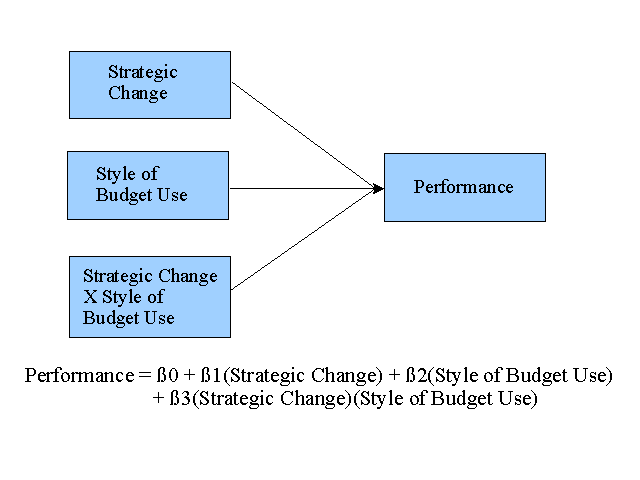
The model is based on the concepts illustrated in the graphic below.
An adaptation of Figure 1 from the paper (illustrated below) conveys the same ideas. The level of strategic change needs to be matched with the appropriate style of budget use (i.e., diagnostic or interactive), to generate high performance.
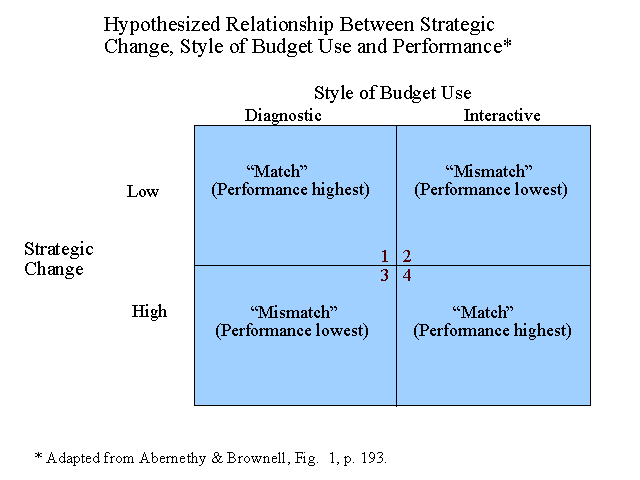
There is a lengthy discussion about the “interactive” and “diagnostic” roles of budgeting and their benefits and drawback. The authors specifically state their expectations as, “The relation between strategic change and performance will be moderated by the extent to which budgets are used interactively (p. 193).” If β3 in the above model is significantly different from zero and positive, then their expectation is supported.
Testing the Model
Data used to test the model was collected by questionnaire to the CEOs of large (greater than 200 beds) public hospitals listed in the Hospital and Health Services Year Book (1994). The hospitals sampled were generally homogenous. The questionnaire was sent and returned by mail and had a 75% (63 useable responses) response rate.Data on the dependent variable (performance) was requested from the financial director and medical director to ensure convergent validity. There were 29 hospitals where the CEO, financial director, and medical director’s performance measures matched. Authors say there was no response bias.
The questionnaires were developed and validated by the authors and based on prior research, semi-structured interviews with industry experts, and pilot testing methods.One instrument asked the CEOs to rate both their strategic position two years ago and currently on a 7-point Likert scale anchored by defender description on one end and prospector on the other. The absolute difference between the two was determined to be the operationalization of strategic change.Some qualitative data from the pilot tests is provided for support of the authors’ use of this measure for strategic change.Another scale was created to measure interactive budget use and respondents were asked to indicate how much they agreed or disagreed (Likert scale) with 4 statements about how they perceive their use of budgeting.A third scale was developed to measure CEOs’ self-ratings of their own performance relative to other hospitals of the same size and function.
Results
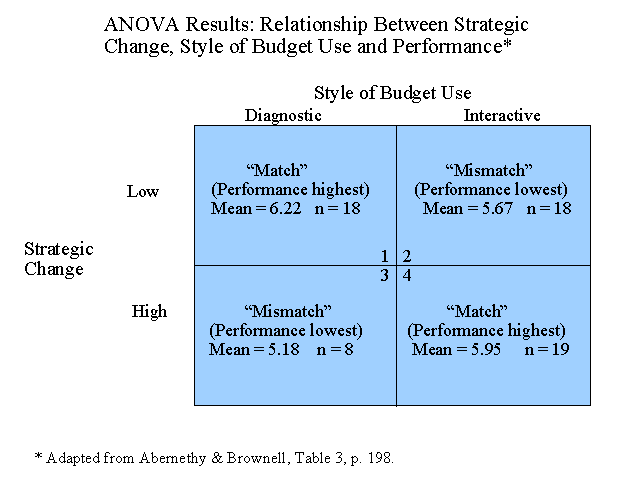
Several statistical procedures were conducted on the data collected. The model was fit and indeed β3 was significant (P<.001), positive (.45), and the model was useful for prediction (r² = .18) thereby indicating that there is an interaction effect of strategic change and style of budget use. To confirm, a Pearson correlation, a nonparametric procedure was also performed on the data. Finally, a two-way ANOVA showed that “performance is highest when interactive use and strategic change are appropriately matched (p. 198).
________________________________________
Related summaries:
Abrahamson, E. 2000. Change without pain. Harvard Business Review (July-August): 75-79. (Summary).
Beer, M. and N. Nohria. 2000. Cracking the code of change. Harvard Business Review (May-June): 133-141. (Summary).
Beynon, R. 1992. Change management as a platform for activity-based management. Journal of Cost Management (Summer): 24-30. (Summary).
Bonabeau, E. 2004. The perils of the imitation age. Harvard Business Review (June): 45-47,49-54. (Summary).
Coutu, D. L. 2002. The anxiety of learning. Harvard Business Review (March): 100-107. (Summary).
Luft, J. L. 1997. Long-term change in management accounting: Perspectives from historical research. Journal of Management Accounting Research (9): 163-197. (Summary).
Pascale, R., M. Millemann and L. Gioja. 1997. Changing the way we change. Harvard Business Review (November-December): 127-139. (Summary).
Rafii, F. and L. P. Carr. 1997. Why major change programs fail: An integrative analysis. Journal of Cost Management (January/February): 41-45. (Summary).
Shields, M. D., F. J. Deng and Y. Kato. 2000. The design and effects of control systems: Tests of direct- and indirect-effects. Accounting, Organizations and Society 25(2): 185-202. (Summary).
Van der Stede, W. A. 2000. The relationship between two consequences of budgetary controls: Budgetary slack creation and managerial short-term orientation. Accounting, Organizations and Society 25(6): 609-622. (Summary).
Walker, K. B. and E. N. Johnson. 1999. The effects of a budget-based incentive compensation scheme on the budgeting behavior of managers and subordinates. Journal of Management Accounting Research (11): 1-28. (Summary).
Williams, J. J. and A. E. Seaman. 2001. Predicting change in management accounting systems: National culture and industry effects. Accounting, Organizations and Society 26(4-5): 443-460. (Summary).