Summary by Rosalyn Mansour
Ph.D. Program in Accounting
University of South Florida, Spring 2004
Control/Controllership Main Page |
Change Management Main Page
Purpose
This study is a replication of the Libby and Waterhouse (1996)1 study that found that “management accounting and control systems (MACS) have a fluid propensity to change, component parts do not change uniformly, and organizational capacity is a strong correlate of MACS change – findings that are contrary to the view that MACS are resistant to change. (p.443).” Since Libby and Waterhouse’s (LW) study was conducted using Canadian firms, Williams and Seaman (2001) replicate and extend this study to Singapore firms using Hofstede’s (1980, 1982, 1991) cultural framework.
The authors start with a literature review supporting the L&W model and then a review of the Hofstede’s (1980, 1982, 1991) national culture framework.
Determinants of MACS changes
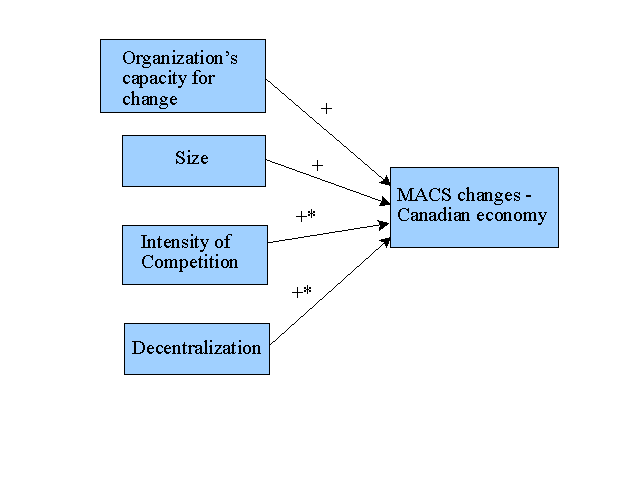
The L&W study was focused on change in MACS at the organizational level and used structural contingency theory. Their independent variables were “organization’s capacity for change, size, intensity of competition, and decentralization (p.445)” The following depicts the findings of the L&W model. The symbol +* means that L&W found no support for the expected positive relationship.
Organization’s capacity for change was expected to be positively related to MACS changes because “it reflects a reservoir of current expertise and experience that can be transformed into change and the adoption of new systems (p.445).” Size’s relationship was expected to be positive because a larger organization should have more resources, which are needed to make MACS changes. Increased intensity of competition was expected to motivate organizations to become more efficient and effective by changing their control systems. Prior work had found decentralization as a impetus for organizational change so it was included, but results were not significant.
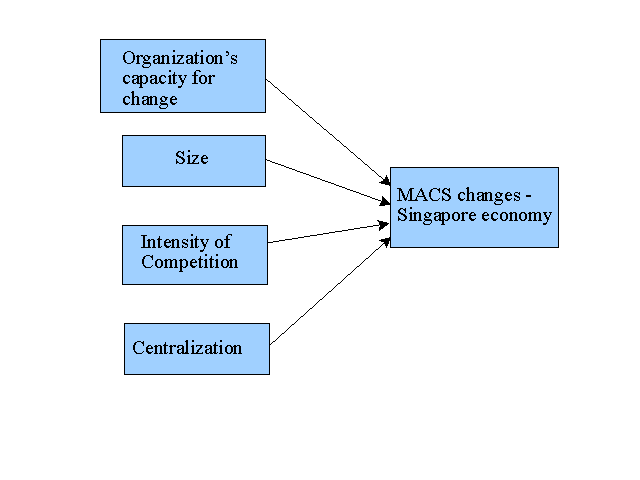
Williams and Seaman substitute centralization for decentralization and extend the model to the Singapore economy. They expect the L&W model to generalize to the Singapore industrial and service sectors.
National Culture Framework
Hoftestede’s (1980) definition of culture was used – “the collective programming of the mind which distinguishes the members of one group from another (1980, p.25) and its four universal dimensions (power distance, individualism, uncertainty avoidance and masculinity) (p.445).”
Power Distance is “the degree to which society accepts that power is distributed unequally in social organizations (p.445).
Uncertainty avoidance is the “degree to which a society is tolerant towards ambiguity and uncertainty (p.445).”
Individualism “reflects the degree to which group members prefer a loosely versus tightly knit society and self-interest over group harmony, respectively (p.445).”
Masculinity is “the degree to which members are achievement-oriented as opposed to modest and need-focused (p.445).”
The hypothesis tested was that “changes in MACS are associated with: more intense competition; larger firm size; greater organizational capacity to learn; and a more centralized organizational structure (p. 447),” within the manufacturing sector. In other words, they had the same hypothesis as L&W, except that L&W had tested “decentralization” instead of centralization.
Research Method
Sample – The final random sample consisted of personnel directors or CFOs of 93 organizations (27% manufacturing, 45% industrial, 28% service). No non-response bias was found. According to the authors, their sample was “remarkably similar to the L&W sample (p.448).”
Dependent Variable - The dependent variable, changes in MACS, was the total reported number of changes to 23 areas identified by the L&W (Appendix A gives measures used), broken into five categories (planning systems, controlling systems, costing systems, directing systems, and decision-making systems).
Independent Variables
Intensity of competition – The instrument used by L&W was not used here because when they pretested it, they found it was biased. Instead, they used a 5-point Likert scale, which asked respondents to rate the intensity of competition in their organization’s environment. The sum of all items was the measure used for intensity of competition.
Centralization – The authors used an abbreviated form of the Aston concentration of authority scale, which asked respondents to identify the most junior job level that has authority to make decisions on a list of 23 organizational policies (p.449). L&W only used 15 of the 23 policies, however, since the authors didn’t know which 15 were used, they used all 23 instead.
Size – like L&W, the natural log of the number of organization’s employees measured size.
Organizational capacity – Again, same as L&W, being the absolute count of the number of systems reported to exist in the organization at June 30, 1997.
Results
The descriptive data for Williams and Seaman’s study is comparable to that in the L&W study. Linear regression was used to test for main effects only. First a linear regression was conducted on the total MACS changes, regardless of sector, and the total MACS changes broken out by the five components (planning, controlling, costing, directing, and decision-making). The authors conclude “for the component analysis, centralization is the only consistent hypothesized determinant of the number of changes in the five different categories of managerial accounting systems (p. 451).”
Next, separate regressions were run for the three sectors of the Singapore economy (manufacturing, industrial, and service). They did this so they could compare the manufacturing sector to the L&W results and then see if they could extend it to the industrial and service sectors. Results for the manufacturing sector did not converge with the L&W results. Overall, “the number of changes in MACS is significantly associated with decreasing competition (P<.05), more centralization (P<.05), and more organizational capacity (P<.10).
For the industrial organizations, centralization was the only significant determinant of increase in MACS as well as the 5 categories of MACS (planning, controlling, costing, directing, and decision-making). For the service sector, the only significant relationships found between the IV and DV were competition, centralization, and size on the planning component of MACS. Overall, the authors observed “centralization, by far, is the most consistent predictor, while competition is the most divergent, in relation to the theoretical expectations (p.453).” In sum, the L&W study did not generalize to the manufacturing firms in Singapore. Furthermore, other than for the organizational capacity for change variable, there was a high degree of convergence between the manufacturing and industrial sectors found in the Williams and Seaman study. However, the similarities that these two sectors had in common did not generalize to the service sector.
_______________________________________________
1 Libby, T. and J. H. Waterhouse. 1996. Predicting change in management accounting systems. Journal of Management Accounting Research (8): 137-150. (Summary).
Other related summaries:
Atkinson, A. A., R. Balakrishnan, P. Booth, J. M. Cole, T. Groot, T. Malmi, H. Roberts, E. Uliana and A. Wu. 1997. New directions in management accounting research. Journal of Management Accounting Research (9): 79-108. (Summary).
Buckley, J. W., M. H. Buckley and H. Chiang. 1976. Research Methodology & Business Decisions. National Association of Accountants. (Summary).
Chenhall, R. H. 2003. Management control system design within its organizational context: Findings from contingency-based research and directions for the future. Accounting, Organizations and Society 28(2-3): 127-168. (Summary).
Chenhall, R. H. and K. Langfield-Smith. 1998. The relationship between strategic priorities, management techniques and management accounting: An empirical investigation using a systems approach. Accounting, Organizations and Society 23(3): 243-264. (Summary).
Covaleski, M. A., M. W. Dirsmith and S. Samuel. 1996. Managerial accounting research: The contributions of organizational and sociological theories. Journal of Management Accounting Research (8): 1-35. (Summary).
Fullerton, R. R. and C. S. McWatters. 2002. The role of performance measures and incentive systems in relation to the degree of JIT implementation. Accounting, Organizations and Society 27(8): 711-735. (Summary).
Hofstede, G. 1987. The cultural context of accounting. In Accounting and Culture: Plenary Session Papers and Discussants' Comments from the 1986 Annual Meeting of the American Accounting Association, edited by B. E. Cushing. American Accounting Association: 1-11. (Summary).
Ittner, C. D. and D. F. Larcker. 1997. Quality strategy, strategic control systems, and organizational performance. Accounting, Organizations and Society 22(3-4): 293-314. (Note).
Jonsson, S. and N. B. Macintosh. 1997. CATS, RATS, and EARS: Making the case for ethnographic accounting research. Accounting, Organizations and Society 22(3-4): 367-386. (Summary).
Kaplan, S. E. and J. T. Mackey. 1992. An examination of the association between organizational design factors and the use of accounting information for managerial performance evaluation. Journal of Management Accounting Research (4): 116-130. (Summary).
Luft, J. L. 1997. Long-term change in management accounting: Perspectives from historical research. Journal of Management Accounting Research (9): 163-197. (Summary).
Luft, J. and M. D. Shields. 2003. Mapping management accounting: Graphics and guidelines for theory-consistent empirical research. Accounting, Organizations and Society 28(2-3): 169-249. (Summary).
Macy, G. and V. Arunachalam 1995. Management accounting systems and contingency theory: In Search of effective systems. Advances in Management Accounting (4): 63-86. (Summary).
Sim, K. L. and L. N. Killough. 1998. The performance effects of complementarities between manufacturing practices and management accounting systems. Journal of Management Accounting Research (10): 325-346. (Summary).