Summary by James R. Martin, Ph.D., CMA
Professor Emeritus, University of South Florida
Behavioral Issues Main Page | Control/Controllership
Main Page | Theories Main Page
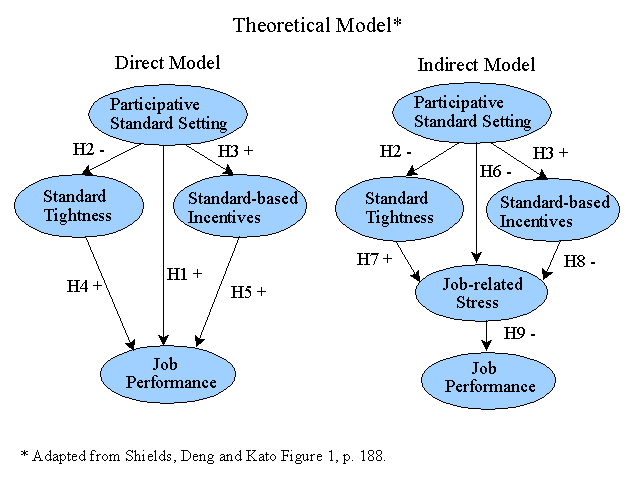
The purpose of this paper is to develop and test two control models (Direct and Indirect) as indicated in the graphic illustrations below. Each model includes three components (i.e., participative standard setting, standard-based incentives, and standard tightness), and job performance as the dependent variable. The direct model assumes that the control system directly affects job performance, while the indirect model assumes that the control system affects job performance indirectly through job-related stress. The main implication of the direct model is that performance can be increased by tightening the performance standard. However, the indirect model predicts the opposite effect, i.e., decreasing the standard, decreases job-related stress and subsequently increases performance.
The hypotheses shown in the graphic illustrations are as follows:
H1: There is a positive relationship between participative standard setting and job performance.
H2: There is a negative relationship between participative standard setting and standard tightness.
H3: There is a positive relationship between participation and standard-based incentives.
H4: There is a positive relationship between standard tightness and job performance.
H5: There is a positive relationship between standard-based incentives and job performance.
H6: There is a negative relationship between participative standard setting and job-related stress.
H7: There is a positive relationship between standard tightness and job-related stress.
H8: There is a negative relationship between standard-based incentives and job-related stress.
H9: There is a negative relationship between job-related stress and job performance.
Questionnaires were distributed to 480 automobile design engineers. This produced 358 usable responses. Each item was measured with multiple indicators. For example, participative standard setting was measured with eight items. Structural equation modeling (LISREL 8) was used to estimate the parameters and to test the hypotheses (see the adaptations of Figures 1 and 2).
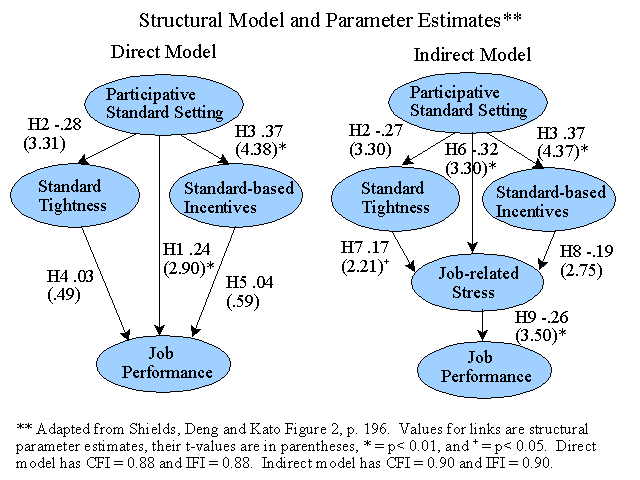
The results indicate that the indirect model had a better overall fit to the data based on two indices, provided a better fit to the data than the direct model in the comparison test, and supported the five hypotheses applicable to the model as indicated in the graphic above. Two of the hypotheses in the direct model were not supported.
Overall the results support the view that standard based incentives and standard tightness are influenced by the level of subordinate participation in standard setting. In addition, the control system components affect job-performance indirectly through job-related stress. The implication of the indirect model is that performance is higher when performance standards are lower.
________________________________________________
Related summaries:
Anthony, R. N. 1964. Framework for analysis. Management Services (March-April): 18-24. (Summary).
Blake, R. R. and J. S. Moulton. 1962. The managerial grid. Advanced Management Office Executive 1(9). (The Grid).
Caplan, E. H. 1966. Behavioral assumptions of management accounting. The Accounting Review (July): 496-509. (Summary).
Chenhall, R. H. 2003. Management control system design within its organizational context: Findings from contingency-based research and directions for the future. Accounting, Organizations and Society 28(2-3): 127-168. (Summary).
Cooper, R. and R. Slagmulder. 2003. Interorganizational costing, Part 1. Cost Management (September/October): 14-21. (Summary).
Ferreira, A. and D. Otley. 2009. The design and use of performance management systems: An extended framework for analysis. Management Accounting Research (December): 263-282. (Summary).
Kalagnanam, S. S. and R. M. Lindsay. 1998. The use of organic models of control in JIT firms: Generalising Woodward's findings to modern manufacturing practices. Accounting, Organizations and Society 24(1): 1-30. (Summary).
Langfield-Smith, K. 1997. Management control systems and strategy: A critical review. Accounting, Organizations and Society 22(2): 207-232. (Summary).
Martin, J. R. Not dated. Simon's levers or control in relation to the balanced scorecard. Management And Accounting Web. Simon'sLeversofControl.htm
Neimark, M. and T. Tinker. 1986. The social construction of management control systems. Accounting, Organizations and Society 11(4-5): 369-395. (Summary).
O'Clock, P. and K. Devine. 2003. The role of strategy and culture in the performance evaluation of international strategic business units. Management Accounting Quarterly (Winter): 18-26. (Summary).
Ouchi, W. G. 1979. A conceptual framework for the design of organizational control mechanisms. Management Science (September): 833-848. (Summary and Comparison of the Control Mechanisms).
Ouchi, W. G. and A. M. Jaeger. 1978. Type Z organization: stability in the midst of mobility. Academy of Management Review (April): 305-314. (Summary).
Parker, L. D. 1984. Control in organizational life: The contribution of Mary Parker Follett. The Academy of Management Review 9(4): 736-745. (Note).
Simons, R. 1995. Control in an age of empowerment. Harvard Business Review (March-April): 80-88. (Summary and related Note).
Spekle, R. F. 2001. Explaining management control structure variety: A transaction cost economics perspective. Accounting, Organizations and Society 26(4-5): 419-441. (Summary).
Sunder, S. 2002. Management control, expectations, common knowledge, and culture. Journal of Management Accounting Research (14): 173-187. (Summary).
Tiessen, P. and J. H. Waterhouse. 1983. Towards a descriptive theory of management accounting. Accounting, Organizations and Society 8(2-3): 251-267. (Summary).
Towry, K. L. 2003. Control in a teamwork environment: The impact of social ties on the effectiveness of mutual monitoring contracts. The Accounting Review (October): 1069-1095. (Towry discusses Social Identity Theory and how it can be applied to vertical and horizontal incentive systems). (Summary) and
White, L. R., A. Van der Merwe, B. D. Clinton, G. Cokins, C. Thomas, K. Templin and J. Huntzinger. 2012. Conceptual Framework for Managerial Costing: Draft Report of the IMA Managerial Costing Conceptual Framework Task Force. IMA. (Summary).
Wing, K. T. 2000. Using enhanced cost models in variance analysis for better control and decision making. Management Accounting Quarterly (Winter): 27-35. (Summary).