Summary by Eileen Z. Taylor
Ph.D. Program in Accounting
University of South Florida, Spring 2004
Behavioral Issues Main Page | Budgeting
Main Page | Control/Controllership Main Page
Introduction
Previous research has examined the effect of increasing budgetary controls on dysfunctional behavior. Specifically, while controls may be effective in reducing budgetary slack, one side effect is that managers then focus on short-term results rather than long-term goals. This paper examines the impact of increasing budgetary controls on slack and time-orientation. However, the author adds two relevant independent variables to the model. Past performance and competitive strategy are considered as antecedents to control choices. Theory is developed, and a new model is tested.
The Model
Hypothesis Development
H1: Rigid budgetary controls are:
a. Negatively related to budgetary slack
b. Positively related to managerial short-term orientation
H2: Budgetary slack and managerial short-term orientation are negatively related.
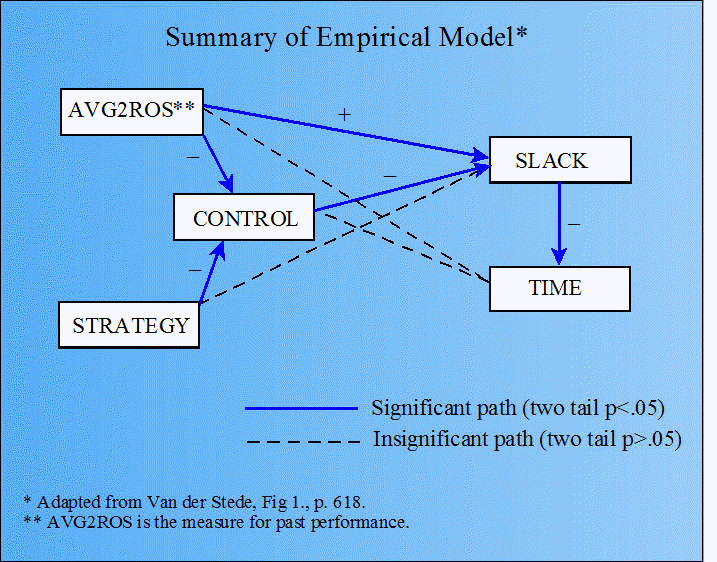
Past research (Dunn, 1993 & Merchant, 1985), has demonstrated that increased budgetary controls lead to less slack, because as the organization focuses on those controls, any slack will be noticed and reduced. However, as a result of the reduction in slack, managers will seek other methods to meet the tighter budget targets. Since managers are limited in their time and ability, it is proposed that they will focus on short-run activities that allow them to meet their budget. This may create an unhealthy emphasis on short-term efforts to the detriment of long-term organizational sustainability. The model, as tested, supports these hypotheses.
H3: Relative to cost leadership strategies, differentiation strategies are:
a. Negatively associated with rigid budgetary controls
b. Positively associated with budgetary slack
Van der Stede examines organizational strategy as a relevant antecedent to budgetary control rigidity. He hypothesizes that differentiation strategies require a more flexible, less rigid control system; hence H3a. A key factor in differentiation strategy is the presence of uncertainty. Past research has demonstrated that since differentiation strategies require innovation, and a focus on long-term goals, rigid budgetary controls are not well-suited for a differentiation strategy. This hypothesis was directly supported by the model.
The author also proposes that differentiation strategies will have a direct effect on budgetary slack. The reasoning behind this is that a differentiation strategy is characterized by ‘fuzzy’ indicators that are difficult to quantify. Therefore, corporate management cannot detect slack as easily in these organizations. Since slack cannot be easily detected, it is difficult for the organization to curb. Therefore, it is hypothesized that a differentiation strategy will lead to more slack. This direct link was not significantly supported by the data. (although an indirect effect exists through control).
H4: Past business unit performance is:
a. Negatively related to rigid budgetary controls
b. Positively related to budgetary slack
c. Negatively related to managerial short-term orientation
Past research has looked at performance as a dependent variable or ‘result’ of certain budgetary control structures. However, there has been limited research that has examined antecedents of control structures, one of which is past performance. Merchant (1985), Onsi (1973) and Schiff & Lewin (1970), have found evidence that increased past performance is associated with increased slack. Merchant and Manzoni (1989) found that a tradeoff between slack and short-term orientation exists. It seems reasonable that in good times, there are looser controls and more potential for slack to exist within organizations. In other words, when there is plenty to go around, no one complains.
The above hypotheses H4a and H4b were supported directly; H4c was indirectly supported through the slack factor.
Method
The research method took the form of a survey questionnaire distributed in Belgium. Therefore, application of findings to US firms may not be supported. The author created several instruments to measure the above constructs. They appeared to be adequately validated through the use of a Cronbach’s alpha analysis.
Structural equation modeling was used to test the complete model. Fit indices indicate that the model has a good fit. Approximately 25.1% of the variance in SLACK was explained by the model. However, only 4.8% of the variance in CONTROL was explained by past performance and strategy, leaving open the possibility that there are other significant antecedents to CONTROL. Additionally, only 6.7% of the variance in TIME was explained by the model.
Possible limitations could arise from the ‘self-reporting’ aspect of the instrument. Participants were requested to rate their perceived time orientation and slack ratings. Additionally, although a short-term orientation may be identified; there is no indication that such an orientation is exclusively negative or even that it is exclusive. Finally, slack is not necessarily a ‘bad’ thing either.
Overall, the author proposes and tests a model that adds two significant independent factors. Future research could examine other possible contextual antecedents. Another possible addition would be to include current performance as a result of slack and short-term orientation, given strategy and past performance as antecedents.
_______________________________________________
Related summaries:
Abernethy, M. A. and P. Brownell. 1999. The role of budgets in organizations facing strategic change: An exploratory study. Accounting, Organizations and Society 24(3): 189-204. (Summary).
Banham, R. 2012. Freed from the budget: Many companies see budgeting as a time-consuming exercise of limited value. Some are resorting to a radical fix: Getting rid of the budget. CFO (September): 41-46. (Summary).
Chenhall, R. H. 2003. Management control system design within its organizational context: Findings from contingency-based research and directions for the future. Accounting, Organizations and Society 28(2-3): 127-168. (Summary).
Francis, A. E. and J. M. Gerwels. 1989. Building a better budget. Quality Progress (October): 70-75. (Summary).
Hope, J. and R. Frazer. 2003. Who needs budgets? Harvard Business Review (February): 108-115. (Summary).
Jensen, M. C. 2001. Corporate budgeting is broken - Let's fix it. Harvard Business Review (November): 94-101. (Summary).
Otley, D. and A. Fakiolas. 2000. Reliance on accounting performance measures: Dead end or new beginning. Accounting, Organizations and Society 25(4-5): 497-510. (Summary).
Roehm, H. A., L. Weinstein, and J. F. Castellano. 2000. Management control systems: How SPC enhances budgeting and standard costing. Management Accounting Quarterly (Fall): 34-40. (Summary).
Sandison, D., S. C. Hansen and R. G. Torok. 2003. Activity-based planning and budgeting: A new approach. Journal of Cost Management (March/April): 16-22. (Summary).
Shields, M. D., F. J. Deng and Y. Kato. 2000. The design and effects of control systems: Tests of direct- and indirect-effects. Accounting, Organizations and Society 25(2): 185-202. (Summary).
Walker, K. B. and E. N. Johnson. 1999. The effects of a budget-based incentive compensation scheme on the budgeting behavior of managers and subordinates. Journal of Management Accounting Research (11): 1-28. (Summary).
Weisenfeld, L. W. and L. N. Killough. 1992. A review and extension of using performance reports: A field study based on path-goal theory. Journal of Management Accounting Research (4): 209-225. (Summary).