Summary by Jason Burkett
Master of Accountancy Program
University of South Florida, Summer 2003
Performance Measures Main Page | Strategy Main Page
| Structure/Restructure Main Page
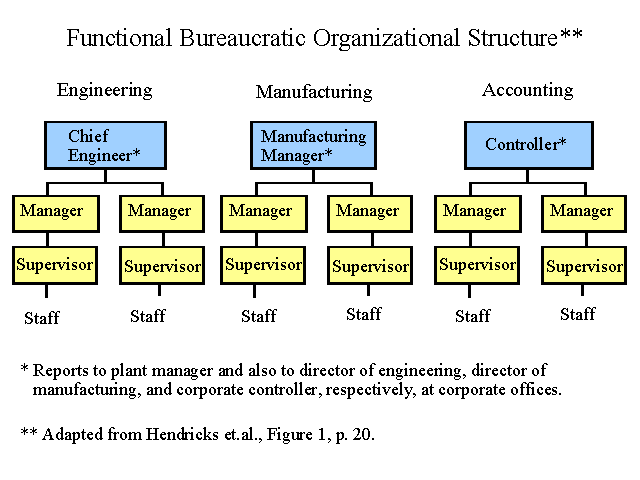
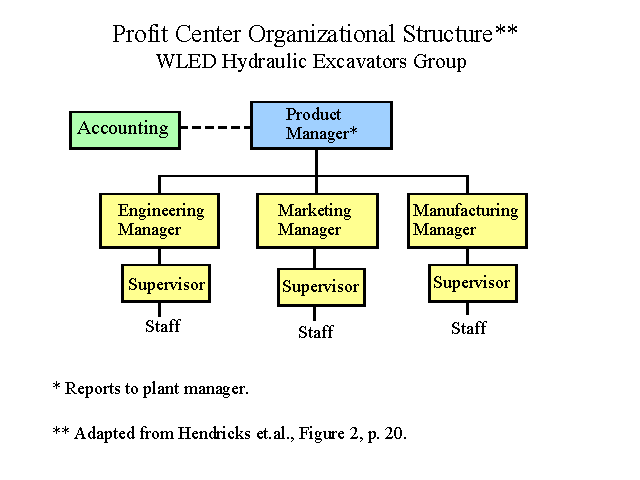
When the Caterpillar Company restructured its overall corporate organization, significant revisions needed to be made to the current standards and methods of measurement. In 1990, Caterpillar restructured from a functional bureaucratic organization into a profit center organization to better meet the company-wide goals of increased customer responsiveness and customer focus. This new structure includes 13 “profit center” divisions and three “service center” divisions that had previously been treated as cost centers. See the illustrations below for graphic views of these changes. Decentralization allowed decisions to be made at lower levels, which gave authority to each division to make decisions about design, pricing, and service. Employees at the lower levels were enabled to develop their skills as “businesspeople.” Their expertise and experience in manufacturing and design proved very beneficial to Caterpillar.
When the Chairman and Vice Chairman of the Board of Caterpillar decided to implement all new performance measures, they solicited input from within the company, as well as from such companies as AT&T and IBM. They had created a short timetable in which to complete the project and new performance measures were to be created quickly. After general concepts for performance measures were created, a team from the corporate accounting department was formed which worked with consultants from Price, Waterhouse, & Co. to make these general concepts more specific for their future implementation. Once the concepts were made more concrete, each employee was given a two-day training session to learn how decisions would affect adherence to these new standards.
Financial Measures
Revenue for products is based on the price in the dealers’ price list. Indirect costs are allocated based on a “cause-and-effect” method, while avoiding “arbitrary allocations of indirect costs to these segments because they can distort profit.” Caterpillar describes a benefit of this method of determining profit as being the ability to push accountability for profits to lower levels of the organization and the ability to create constructive conflict among units.
Nonfinancial Measures
Although Caterpillar uses such figures as customer/employee satisfaction, delivery performance, and process improvement, the predominant measure is the efficiency ratio of direct labor hours/machine hours. However, this measure obviously can motivate actions that would be destructive in the long run, so it is being de-emphasized as the primary measure. Nonfinancial measures also have the added benefit of being reportable on a more timely basis than financial numbers, and corrective action can consequently be taken much quicker.
Service Department Measures
Service departments include Business Resources (accounting), Human Resources, and Technology Resources. The chief measurement of these departments is in comparing actual vs. budgeted spending. User satisfaction provides the most crucial nonfinancial measurement.
How can these principles be applied to your company?
Support the users’ needs.
Performance measures should drive the desired behavior.
“Why is this performance measure needed?”
Select a limited number of relevant, understandable measures.
Report results frequently.
Educate employees.
Inform users how decisions will ultimately affect financial results
Examine trends.
It is likely more useful to compare current numbers with last year’s numbers, as opposed to budgeted numbers.
Assess the system’s ability to collect data.
Modifications may be required in order to collect appropriate information for decision-making.
Regularly review the system.
A system must evolve within a dynamic business environment.
__________________________________________
Related summaries:
Berliner, C. and J. A. Brimson, eds. 1988. Chapter 6: CMS performance measurement. Cost Management for Today's Advanced Manufacturing: The CAM-I Conceptual Design. Harvard Business School Press. (Summary).
Clinton, B. D. and S. Chen. 1998. Do new performance measures measure up? Management Accounting (October): 38, 40-43. (Summary).
Fullerton, R. R. 2003. Performance measurement and reward systems in JIT and non-JIT firms. Cost Management (November/December): 40-47. (Summary).
Fullerton, R. R. and C. S. McWatters. 2002. The role of performance measures and incentive systems in relation to the degree of JIT implementation. Accounting, Organizations and Society 27(8): 711-735. (Summary).
Ittner, C. D. and D. F. Larcker. 1998. Innovations in performance measurement: Trends and research implications. Journal of Management Accounting Research (10): 205-238. (Summary).
Ittner, C. D. and D. F. Larcker. 2003. Coming up short on nonfinancial performance measurement. Harvard Business Review (November): 88-95. (Summary).
Kaplan, R. S. and D. P. Norton. 1992. The balanced scorecard - Measures that drive performance. Harvard Business Review (January/February): 71-79. (Summary).
Lessner, J. 1989. Performance measurement in a just-in-time environment: Can traditional performance measurements still be used? Journal of Cost Management (Fall): 23-28. (Summary).
Otley, D. and A. Fakiolas. 2000. Reliance on accounting performance measures: Dead end or new beginning. Accounting, Organizations and Society 25(4-5): 497-510. (See also Hartmann, AOS same issue, pp. 451-482). (Summary).
Reilly, G. P. and R. R. Reilly. 2000. Using a measure network to understand and deliver value. Journal of Cost Management (November/December): 5-14. (Summary).
Ridgway, V. F. 1956. Dysfunctional consequences of performance measurements. Administrative Science Quarterly 1(2): 240-247. (Summary).
Roehm, H. A. and J. R. Castellano. 1999. The danger of relying on accounting numbers alone. Management Accounting Quarterly (Fall): 4-9. (Summary).
Schonberger, R. J. 2008. Lean performance management (Metrics don't add up). Cost Management (January/February): 5-10. (Note: Schonberger criticizes the KPI or scorecard approach from the lean enterprise perspective. Summary).
Stivers, B. P., T. J. Covin, N. G. Hall and S. W. Smalt. 1998. How nonfinancial performance measures are used. Management Accounting (February): 44, 46-49. (Summary).
Tatikonda, L. U. and R. J. Tatikonda. 1998. We need dynamic performance measures. Management Accounting (September): 49-53. (Summary).
Vollmann, T. 1990. Changing manufacturing performance measurements. Proceedings of the Third Annual Management Accounting Symposium. Sarasota: American Accounting Association: 53-62. (Summary).