Summary by Kevin Wrobel
Master of Accountancy Program
University of South Florida, Summer 2002
Balanced Scorecard Main Page | Performance
Measures Main Page
This article affirms the need for a performance measurement, but claims that the current information being provided to managers is obsolete and in some instances dysfunctional to the goals of an organization. The authors describe the types of information managers need to achieve an organizations goals, how to implement such a system, and a case that was successful.
Designing an Effective Performance Measurement System
Performance measures must be current and relevant in order to be useful to a dynamic business environment. Static measures often outlive their usefulness, such as direct labor efficiency. The alignment between vision, strategy, programs, measurement, and rewards must be maintained at all times.
Key steps in designing an effective performance measurement system include:
1. Identifying a vision and strategic goals.
2. Translating goals into specific subgoals.
3. Profiling existing systems.
4. Defining appropriate measures.
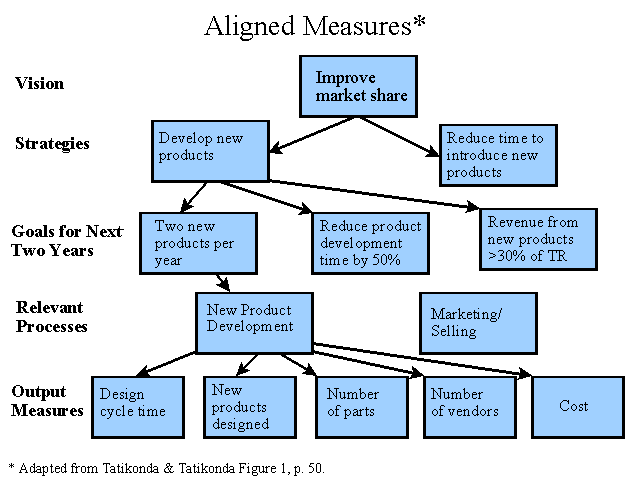
The illustration below was designed to show how measures are aligned with goals.
The questions management must ask to design a world-class performance measurement system:
1. What should we measure?
2. When should we measure?
3. What are the links between measures at different levels?
4. How can we balance between conflicting goals?
5. How can we develop organizational tension and learning needs to be addressed?
What to Measure
This varies from company to company and from one level of management to the next. Top management needs summarized comprehensive information, while lower levels of management need operational measures on a frequent basis. In designing a performance measurement system, there needs to be a small number of measures that are in line with organizational goals.
When to Measure
Frequency of measurement depends on the nature of the information. Most operational measurements need to be measured on a daily basis, such as downtime and deviations from schedule. Measures such as setup times and delivery time can be measured on a weekly basis. Other measures such as customer returns, customers lost/gained can be measured on a monthly or annual basis.
Links Between Measures at Different Levels and Departments
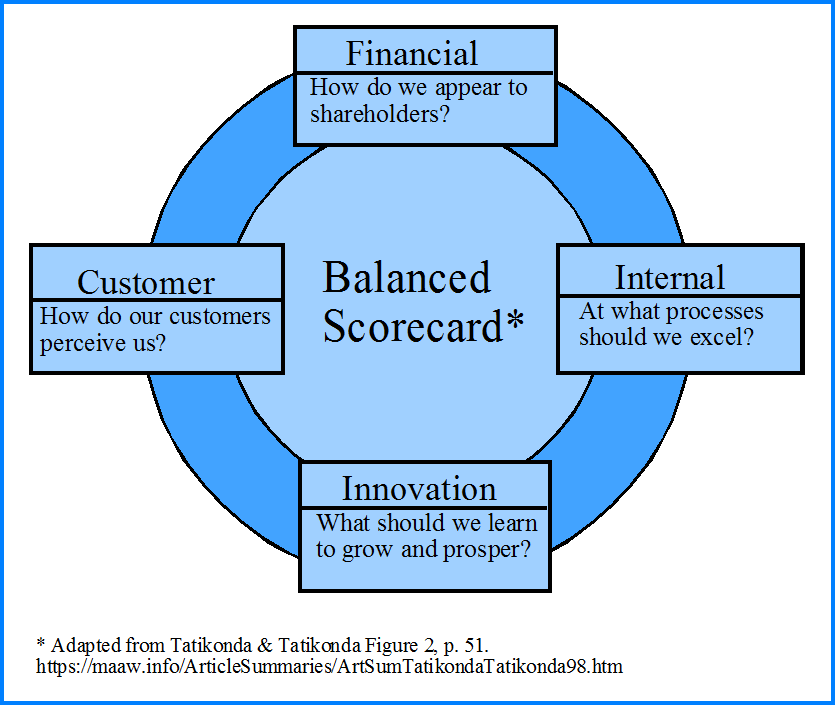
The use of a Balanced Scorecard gives managers a comprehensive and timely evaluation of business performance. The four key and linked business perspectives that the Balanced Scorecard focuses on are the shareholder, customer, internal, and innovation as indicated in the following graphic.
The development of a Balanced Scorecard has four steps of identifying vision and goals:
1. Translating vision into strategic goals.
2. Communication the vision and linking strategies, performance measures, and rewards.
3. Integrating business and financial plans.
4. Providing feedback and learning.
Financial Perspective
Financial success can be measured by profit, cash flow, return on investment, market share, and earnings per share.
Customer Perspective
How should the company appear to its customers? The company must translate the vision into specific measures of quality, cost, and customer satisfaction.
Internal Business Perspective
In order to satisfy shareholder's and customers, a company must excel in the business process. Tools and techniques to assist in this goal are ABC, ABM, JIT, TQM, reengineering, and measures such as percent of defects and warranty costs.
Learning and Growth
In order to achieve its goal, a company must sustain the ability to change and improve. The company must continuously improve its processes and develop new products through learning and innovation.
Organizational Tension an Learning
Organizational tension is created by the gap between an organization's desired future and its present position. If the organization is continuously learning and tension exists, the result will be organizational improvements.
Implementing a New System
Change is almost always met with resistance, therefore when an organization decides to implement a new measurement system it would be wise to communicate the need for change and involve the workers. The authors list three phases of implementation that most organizations go through when attempting to improve performance measures:
1. Phase 1 - This phase involves tinkering with existing cost accounting systems. The organization usually finds that an improved cost accounting system does not fix problems of poor performance measures.
2. Phase 2 - This phase involves cutting the Gordian Knot. The separation of performance measures from cost accounting measures. This involves separating internal and external accounting.
3. Phase 3 - This phase involves changing strategies, actions, and measures. The organization shifts focus of attitude and behavior.
Conclusion
There is a real need for change among the current performance measurement systems. Performance measures are critical for the continued success of an organization.
_____________________________________________
Related summaries:
Chow, C. W., K. M. Haddad, and J. E. Williamson. 1997. Applying the balanced scorecard to small companies. Management Accounting (August): 21-27. (Summary).
Clinton, B. D., and H. Ko-Cheng. 1997. JIT and the balanced scorecard: Linking manufacturing control to management control. Management Accounting (September): 18-24. (Summary).
Epstein, M. J. and J. Manzoni. 1997. The balanced scorecard and tableau de bord: Translating strategy into action. Management Accounting (August): 28-36. (Summary).
Fonvielle, W. and L. P. Carr. 2001. Gaining strategic alignment: Making scorecards work. Management Accounting Quarterly (Fall): 4-14. (Summary).
Forsythe, R., J. A. Bunch and E. J. Burton. 1999. Implementing ABC and the balanced scorecard at a publishing house. Management Accounting Quarterly (Fall): 10-18. (Summary).
Grojer, J. 2001. Intangibles and accounting classifications: In search of a classification strategy. Accounting, Organizations and Society 26(7-8): 695-713. (Summary).
Hoque, Z. and W. James. 2000. Linking the balanced scorecard measures to size and market factors: Impact on organizational performance. Journal of Management Accounting Research (12): 1-17. (Summary).
Ittner, C. D. and D. F. Larcker. 2003. Coming up short on nonfinancial performance measurement. Harvard Business Review (November): 88-95. (Summary).
Kaplan, R. S. and D. P. Norton. 1997. Why does business need a balanced scorecard? Journal of Cost Management (May/June): 5-10. (Summary).
Kaplan, R. S. and D. P. Norton. 2000. Having trouble with your strategy? Then map it. Harvard Business Review (September-October): 167-176. (Summary).
Kaplan, R. S. 1998. Innovation action research: Creating new management theory and practice. Journal of Management Accounting Research (10): 89-118. (Summary).
Kaplan, R. S. and D. P. Norton. 1992. The balanced scorecard - Measures that drive performance. Harvard Business Review (January/February): 71-79. (Summary).
Kaplan, R. S. and D. P. Norton. 1996. The Balanced Scorecard: Translating Strategy into Action Boston: Harvard Business School Press. (Summary).
Kaplan, R. S. and D. P. Norton. 2001. The Strategy-Focused Organization: How Balanced Scorecard Companies Thrive in the New Business Environment. Harvard Business School Press. (Summary).
Kaplan, R. S. and D. P. Norton. 2001. Transforming the balanced scorecard from performance measurement to strategic management: Part I. Accounting Horizons (March): 87-104. (Summary).
Kaplan, R. S. and D. P. Norton. 2001. Transforming the balanced scorecard from performance measurement to strategic management: Part II. Accounting Horizons (June): 147-160. (Summary).
Lipe, M. and S. Salterio. 2000. The balanced scorecard: Judgmental effects of common and unique performance measures. The Accounting Review (July): 283-298. (Summary).
Lipe, M. G. and S. Salterio. 2002. A note on the judgmental effects of the balanced scorecard's information organization. Accounting, Organizations and Society 27(6): 531-540. (Summary).
Lyons, B., A. Gumbus and D. E. Bellhouse. 2003. Aligning capital investment decisions with the balanced scorecard. Journal of Cost Management (March/April): 34-38. (Summary).
Martinsons, M., R. Davison and D. Tse. 1999. The balanced scorecard: A foundation for the strategic management of information systems. Decision Support Systems (25): 71-88. (Summary).
Norreklit, H. 2003. The balanced scorecard: What is the score? A rhetorical analysis of the balanced scorecard. Accounting, Organizations and Society 28(6): 591-619. (Summary).
Paladino, B. 2007. 5 key principles of corporate performance management: How do Balanced Scorecard Hall of Fame, Malcolm Baldrige, Sterling, Fortune 100, APQC, and Forbes award winners drive value? Strategic Finance (June): 39-45. (Note).
Ridgway, V. F. 1956. Dysfunctional consequences of performance measurements. Administrative Science Quarterly (September): 240-247. (Summary).