Summary by Michele Martinez
Ph.D. Program in Accounting
University of South Florida, Spring 2002
Balanced Scorecard Main Page | Performance
Measures Main Page | Strategy Main Page
Individuals have currently expressed concerns over the traditional performance measures that focus solely on financial metrics. Gaining attention in management accounting research is the use of the balanced scorecard (BSC) way of integrating financial and nonfinancial measures. The BSC views organizational performance from four dimensions: financial, customers, internal business processes, and learning and growth. The BSC has the potential to provide planners with a way of expressing and testing a model of cause and effect in the organization. In addition, the BSC can provide managers with an integrative framework to manage organizational activities. However, there is little empirical evidence outside the U.S. on the current practice of the BSC. Thus, this paper is an attempt to contribute to this area of research.
Purpose
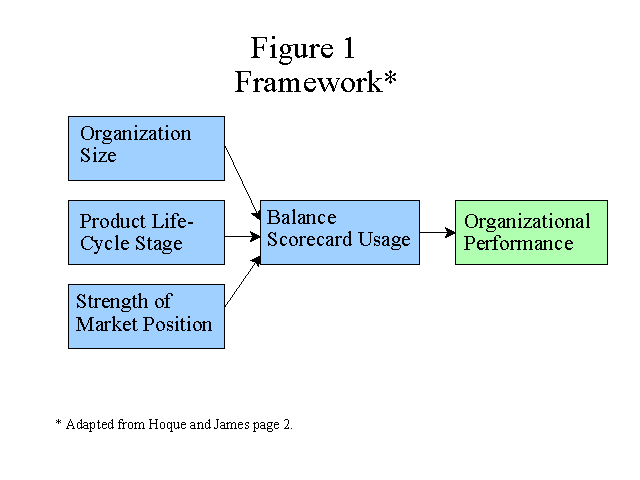
The purpose of this study as stated by the authors is to search for a relationship between the BSC usage and (1) organization size, (2) product life-cycle stage, and (3) strength of market position. In addition, this study looks for a contingent relationship between organizational performance (the outcome variable) and the match between BSC usage and the three contextual variables.
Framework
Theory
This study utilizes a contingency theoretical perspective. The authors consider size of organization, product life-cycle, and market position as potential contextual factors of BSC usage and explore how organizational performance is affected by different uses of the BSC in different settings.
BSC looks at the following four key perspectives:
Financial Perspective – includes profitability measures such as operating income, sales growth, and generation of cash flow.
Customer Perspective – encompasses such measures as customer satisfaction, customer retention, and customer profitability.
Internal-business–processes Perspective – the key measures include product design, product development, and quality.
Learning and growth Perspective – measures the ability of employees, information systems, and organizational procedures to manage the business and adapt to change.
The use of the BSC means putting a handful of strategically critical measures together in a single report in a way that makes cause and effect relationships transparent to keep management from sub optimizing by improving one measure at the expense of another.
Hypotheses
H1: BSC usage is positively associated with: (a) larger organization size; (b) businesses with products at the early/growth stage; and (c) businesses with a strong market position.
H2: The effect of the BSC reliance on organizational performance will be more beneficial for large organizations than for small organizations.
H3: The effect of the BSC reliance on organizational performance will be more beneficial for organizations with products at the early life-cycle stage than for organizations with products at the mature stage.
H4: The effect of the BSC reliance on organizational performance will be more beneficial for organizations with a strong market position than for organizations a weak market position.
Methodology
A questionnaire was mailed to the chief financial controllers (CFC) of 188 Australian manufacturing firms in July 1997. These companies were randomly chosen from the Business Who’s Who of Australia. The useable response rate was 35.1%. A sample of nonrespondents were contacted to determine nonresponse bias, none was detected, and t-tests to determine possible response bias (industry, firm size, and performance indices) were conducted between the first and second mailings, again none was detected.
Measurement of Variables
Organization Size – measured using sales turnover, total assets, and number of employees.
Product life-cycle stage – measured using an instrument adapted from Merchant (1984).
Market Position – measured by asking respondents to indicate on a five-point Likert scale their company’s revenue share.
BSC Usage – measured using a 20-item scale. The instrument was comprised of items that incorporated Kaplan and Norton’s four dimensions of the BSC.
Organizational Performance – measured by appraising five dimensions of performance: return on investment, margin on sales, capacity utilization, customer satisfaction, and product quality.
Results
H1: supported (greater BSC usage is associated with larger organization size and businesses with products at the early/growth stage. Did not support that greater BSC usage is associated with businesses with a strong market position.)
H2-H4: not supported
Conclusion
This study reports a significant association between size and BSC usage; thus as size increases organizations find it more practical and useful to place greater emphasis on the BSC. Additionally, a positive association is found between early product life-cycle and a greater reliance on BSC. No support was found for market position, however, this may be due to the fact that organizations in a weak financial position may be motivated to change their strategy and therefore will need to rely more on the BSC. BSC usage is associated with increased organizational performance but this relationship does not significantly depend on organizational size, product life-cycle, or market position.
Overall, it can be concluded that larger firms make more use of the measures in the questionnaire than do smaller firms and firms with more new products make more use of new-product-development measures.
Limitations
Generalizability
Measurement of the extent of BSC usage
Small sample size
____________________________________________
Related summaries:
Kaplan, R. S. and D. P. Norton. 1992. The balanced scorecard - Measures that drive performance. Harvard Business Review (January/February): 71-79. (Summary).
Kaplan, R. S. and D. P. Norton. 1993. Putting the balanced scorecard to work. Harvard Business Review (September-October): 134-147. (Summary).
Kaplan, R. S. and D. P. Norton. 1996. The Balanced Scorecard: Translating Strategy into Action Boston: Harvard Business School Press. (Summary).
Kaplan, R. S. and D. P. Norton. 1996. Using the balanced scorecard as a strategic management system. Harvard
Business Review (January-February): 75-85. (Summary).
Kaplan, R. S. and D. P. Norton. 1997. Why does business need a
balanced scorecard? Journal of Cost Management (May/June): 5-10. (Summary).
Kaplan, R. S. and D. P. Norton. 2000. Having trouble with your strategy? Then map it. Harvard Business Review (September-October):
167-176. (Summary).
Kaplan, R. S. and D. P. Norton. 2001. The Strategy-Focused Organization: How Balanced Scorecard Companies Thrive in the New Business Environment.
Harvard Business School Press. (Summary).
Kaplan, R. S. and D. P. Norton. 2001. Transforming the balanced scorecard from performance measurement to strategic management: Part I.
Accounting Horizons (March): 87-104. (Summary).
Kaplan, R. S. and D. P. Norton. 2001. Transforming the balanced scorecard from performance measurement to strategic
management: Part II. Accounting Horizons (June): 147-160. (Summary).
Kaplan, R. S. and D. P. Norton. 2004. Measuring the strategic readiness of intangible assets. Harvard Business Review (February): 52-63. (Summary).
Lipe, M. and S. Salterio. 2000. The balanced scorecard: Judgmental effects of common and unique performance measures. The Accounting Review (July): 283-298. (Summary).
Lipe, M. G. and S. Salterio. 2002. A note on the judgmental effects of the balanced scorecard's information organization. Accounting, Organizations and Society 27(6): 531-540. (Summary).
Lyons, B., A. Gumbus and D. E. Bellhouse. 2003. Aligning capital investment decisions with the balanced scorecard. Journal of Cost Management (March/April): 34-38. (Summary).
Martin, J. R. Not dated. Balanced scorecard concepts. Management And Accounting Web. (Summary).
Martinsons, M., R. Davison and D. Tse. 1999. The balanced scorecard: A foundation for the strategic management of information systems. Decision Support Systems (25): 71-88. (Summary).
Norreklit, H. 2003. The balanced scorecard: What is the score? A rhetorical analysis of the balanced scorecard. Accounting, Organizations and Society 28(6): 591-619. (Summary).
Paladino, B. 2007. 5 key principles of corporate performance management: How do Balanced Scorecard Hall of Fame, Malcolm Baldrige, Sterling, Fortune 100, APQC, and Forbes award winners drive value? Strategic Finance (June): 39-45. (Note).
Schonberger, R. J. 2008. Lean performance management (Metrics don't add up). Cost Management (January/February): 5-10. (Note: Schonberger criticizes the KPI or scorecard approach from the lean enterprise perspective. Summary).