Chapter 6: CMS Performance Measurement
Study Guide by James R. Martin, Ph.D., CMA
Professor Emeritus, University of South Florida
CAM-I Main Page | Cost
Management Main Page
According to a footnote, most of this chapter was written by Lawrence J. Utzig of General Electric Company. Some additional material was provided by Tom Pryor who worked for Motorola before joining CAM-I as the Director of the CMS Project. Tom is currently President of Integrated Cost Management Systems (ICMS).
Performance measurements are a key factor in the successful implementation of a company's strategic plan. Performance measurements:
1. measure business and plant performance in relation to the
objectives of the business plan,
2. provide timely information for identifying and eliminating activities that add no value, and
3. provide timely information on causes of non-value activity that may lead to improvement.
Most non-value added activity is caused by factors such as functional layouts, long setups, unsynchronized flow, material shortages, quality checks, centralized stockrooms, scheduling-system problems, and measurement inefficiencies. Many traditional performance measurements do not encourage the elimination of non-value added activities. For example, measuring the efficiency of individual workers and foreman, and measuring machine utilization encourages unnecessary production. Inventory valuation methods encourage high inventory to absorb overhead costs and increase income. Material price variances may cause an emphasis on vendor pricing rather than quality. All this encourages sub-optimization for the plant.
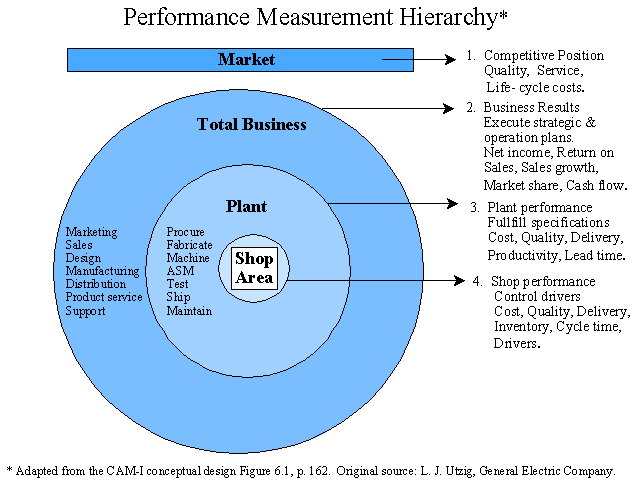
The CAM-I Performance Measurement Hierarchy
The CAM-I CMS approach to performance measurement is based on a hierarchy that includes four levels of management as follows:
1. Market level,
2. Business level,
3. Plant level, and
4. Shop-floor level.
The performance measurement hierarchy along with some appropriate measurements for each management level are provided in the graphic illustration below.
Performance measurements should be adaptable to changes in business needs and should be prioritized according to the company's strategic success factors.
The steps required to eliminate non-value added activities include:
1. Understanding what drives these activities, and
2. Establishing performance measurements such as lead time, inventory, conversion cost, quality, schedule performance and machine hours per part.
Different performance measures are needed at different stages of a product's life cycle.
Traditional Performance Measures Inhibit Optimized Manufacturing
The following table is based on Table 6.3 (p. 170) and illustrates some of the problems caused by traditional performance measurements.
| Traditional Measurements and Their Effects* | ||
| Measurement | Action | Result |
| Purchase Price | Purchasing increases order quantity to receive a lower price, ignoring quality and delivery | Excess inventory, increased carrying costs, vendor with best quality and delivery may be overlooked |
| Machine Utilization | Run machine in excess of unit requirements to maximize machine utilization | Excess inventory as well as the wrong inventory |
| Setup
included in Standards |
Encourages high run quantity | Excess inventory |
| Scrap factor built into standard costs |
Supervisor takes no action if there is no variance | Inflated standard, minimum scrap threshold build in |
| Standard cost overhead absorption |
Supervisor overproduces WIP to obtain overhead absorption in excess of expenses | Excess inventory |
| Indirect/direct headcount ratio |
Management, not total cost, controls the ratio | Indirect labor standards wrongly established; total cost not in control |
| Scrap dollars | Scrap dollars drive corrective action priority | Direct-level impact on flow hidden in dollars |
| Cost center reporting | Management focus is on cost centers, not activities | Opportunities to reduce costs are missed when common activities are overlooked |
| Labor reporting. | Focus is on direct labor, which is fixed and relatively small, instead of on overhead, which is variable and large | Missed cost reduction opportunities; major overhead activities are not exposed |
| Earned labor dollars | Supervisor maximizes earned labor, keeps workers busy | Excess inventory, schedule attainment receives lower priority; emphasis on output |
| Overhead rate | Management, not total cost, controls rate | Improperly established overhead levels; high cost activities are hidden |
| * Adapted from Table 6.3, p. 170. Original source: Tom Pryor. | ||
Key Performance Measures
Some measurements that are generally viewed as key performance indicators for advanced manufacturing include:
Lead time,
Total value-added versus non-value added time and cost,
Schedule attainment,
Product quality,
Throughput,
Engineering changes,
Machine hours per part,
Plant, equipment and tooling
reliability,
Cycle time,
Broad management/worker involvement,
Problem support,
High value-added design, and
Forecast accuracy.
Steps to Implement a Performance Measurement System
1. Develop a hierarchical measurement system that links business, plant, and shop-floor performance.
2. Identify and quantify the company's cost and performance drivers.
3. Identify non-value-added activities.
4. Eliminate inhibiting measures.
5. Simplify the manufacturing process to minimize or eliminate non-value-added activities.
__________________________________________
Related summaries:
Berliner, C., and J. A. Brimson, eds. 1988. Cost Management for Today's Advanced Manufacturing: The CAM-I Conceptual Design. Boston: Harvard Business School Press. (Summary Chapters 1-3).
Clinton, B. D. and S. Chen. 1998. Do new performance measures measure up? Management Accounting (October): 38, 40-43. (Summary).
Fullerton, R. R. 2003. Performance measurement and reward systems in JIT and non-JIT firms. Cost Management (November/December): 40-47. (Summary).
Fullerton, R. R. and C. S. McWatters. 2002. The role of performance measures and incentive systems in relation to the degree of JIT implementation. Accounting, Organizations and Society 27(8): 711-735. (Summary).
Hendricks, J. A., D. G. Defreitas and D. K. Walker. 1996. Changing performance measures at Caterpillar. Management Accounting (December): 18-22, 24. (Summary).
Ittner, C. D. and D. F. Larcker. 1998. Innovations in performance measurement: Trends and research implications. Journal of Management Accounting Research (10): 205-238. (Summary).
Ittner, C. D. and D. F. Larcker. 2003. Coming up short on nonfinancial performance measurement. Harvard Business Review (November): 88-95. (Summary).
Kaplan, R. S. and D. P. Norton. 1992. The balanced scorecard - Measures that drive performance. Harvard Business Review (January/February): 71-79. (Summary).
Lessner, J. 1989. Performance measurement in a just-in-time environment: Can traditional performance measurements still be used? Journal of Cost Management (Fall): 23-28. (Summary).
Martin, J. R. Not dated. Activity based management models. Management And Accounting Web. ABMModels
Otley, D. and A. Fakiolas. 2000. Reliance on accounting performance measures: Dead end or new beginning. Accounting, Organizations and Society 25(4-5): 497-510. (See also Hartmann, AOS same issue, pp. 451-482). (Summary).
Reilly, G. P. and R. R. Reilly. 2000. Using a measure network to understand and deliver value. Journal of Cost Management (November/December): 5-14. (Summary).
Ridgway, V. F. 1956. Dysfunctional consequences of performance measurements. Administrative Science Quarterly 1(2): 240-247. (Summary).
Roehm, H. A. and J. R. Castellano. 1999. The danger of relying on accounting numbers alone. Management Accounting Quarterly (Fall): 4-9. (Summary).
Sandison, D., S. C. Hansen and R. G. Torok. 2003. Activity-based planning and budgeting: A new approach. Journal of Cost Management (March/April): 16-22. (Summary).
Schonberger, R. J. 2008. Lean performance management (Metrics don't add up). Cost Management (January/February): 5-10. (Note: Schonberger criticizes the KPI or scorecard approach from the lean enterprise perspective. Summary).
Shields, M. D. and S. M. Young. 1989. A behavioral model for implementing cost management systems. Journal of Cost Management (Winter): 17-27. (Summary).
Stivers, B. P., T. J. Covin, N. G. Hall and S. W. Smalt. 1998. How nonfinancial performance measures are used. Management Accounting (February): 44, 46-49. (Summary).
Tatikonda, L. U. and R. J. Tatikonda. 1998. We need dynamic performance measures. Management Accounting (September): 49-53. (Summary).
Vollmann, T. 1990. Changing manufacturing performance measurements. Proceedings of the Third Annual Management Accounting Symposium. Sarasota: American Accounting Association: 53-62. (Summary).