Summary by Hanna Morales
Master of Accountancy Program
University of South Florida, Summer 2002
Behavioral Issues Main Page | CAM-I
Main Page | Cost Management Main Page
In an attempt to help firms plan and control the costs of advanced manufacturing technologies (AMT) like, Just-In-Time, Total Quality Control, robotics, and computer integrated manufacturing (CIM), Computer Aided Manufacturing-International, Inc. (CAM-I) developed a new conceptual model referred to as a cost management system (CMS). (Note: CAM-I changed its name since this article was written to Consortium for Advanced Manufacturing - International). The main idea of this new model is to develop a strategy that focuses on behavioral issues rather than technical, mainly from recognizing the significant role human behavior plays in cost management. It "requires firms to change their philosophy from managing by the numbers to managing by a commitment to continuous improvement" (27). Therefore, the main goal "is to identify opportunities for, and monitor progress toward, continuous improvement" (17). The behavioral aspect mainly focuses on people and culture, of which are means of managing the activities and behavior that cause costs.
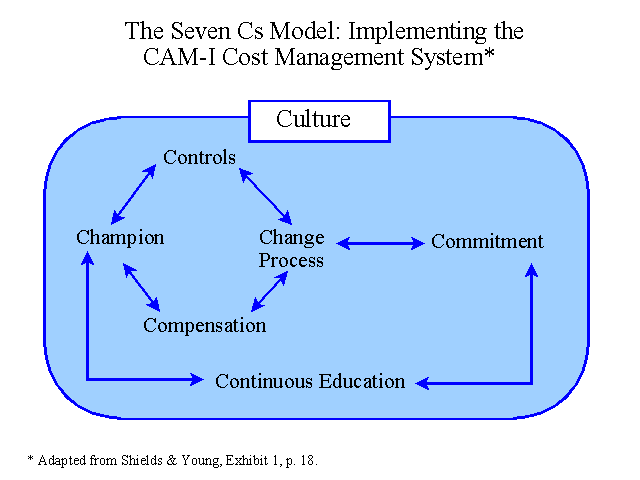
"The Seven Cs Model " is used to manage the cost-generating activities. The seven Cs are: culture, champion, change process, commitment, controls, compensation, and continuous education as illustrated in the exhibit below.
Culture. "Corporate culture is the mindset of employees, including their shared beliefs, values, and goals" (18) together with trust, collaboration, and honesty. The three types are functional, dysfunctional, and ill defined.
A Functional culture is supported by high worker involvement and participation, goal congruence between employees and management, and teamwork. This type supports a healthy organization and is most appropriate for promoting continuous improvement.
A Dysfunctional culture is run by overbearing management causing employees to have poor attitudes and low commitment to the organization, which leads to high turnover of employees.
An Ill-defined culture is practically a collection of employees with no similarity in values, beliefs, and/or goals.
Champion. The champion is the main person responsible for making CMS work. He/she usually comes from the higher level of the hierarchy. He/she guides the much needed "implementation team," which includes a sponsor, project manager, integrator/facilitator, and the champion him/herself.
Change Process. The key elements in this process are:
Top management support - senior executives might resist due to reduction of short-term profits and earnings per share. They should disclose the changes and realize that their performance in capital markets are dependent on expected long-term future cash flows;
Financial resources which are required for funding technology and continuing education;
Realistic time frame that allows change;
Evaluation process that reports the changes in performance of products, activities, etc., as a result of the CMS introduction;
And a definite strategy - Six possibilities are identified: revolutionary (simultaneous change), evolutionary (one change of unit at a time), greenfield (start from scratch), top-down (centralized), bottom-up (participative decision making), and simultaneous top-down and bottom-up (extensive involvement and participation of employees with management developing the basic outline and process for implementation).
Commitment. CMS’ central philosophy is managing by commitment to continuous improvement, which should be supported by top management and employees. Different measures of performance and new compensation systems might be a threat to employees. Firms should have counseling and education programs to describe the changes and its benefits to their employment.
Controls. There are three types: JIT/TQC, organizational structure, and teams.
A benefit taken from JIT/TQC is that controls are based on visual control rather than paper. Visual control is more timely, less expensive, more effective, and efficient. Information is posted publicly about current performance to encourage continuous improvement.
Traditional organizational structure that consists of horizontal and vertical differentiation should have controls such as budgets, formal lines of authority, and standard rules and operating procedures to integrate and coordinate its subunits.
Teams should cut across the traditional functional areas. The smaller number of team-based vertical levels, the better. With horizontal structure, the central idea is the pull philosophy, which means having products available upon demand (24).
Compensation. Five important changes that need be made in the system are suggested.
Motivate employees to produce a certain level by providing maximum pay when actual output reaches the targeted level.
Base it on team performance and individual skills.
Emphasize long-term performance such as the life cycle of a product.
Encourage innovation by letting employees take some risks.
Use non-financial rewards to create an atmosphere of positive reinforcement and success.
Continuous Education. Education should be "ongoing - from one educational module to another." The notion of continuous improvement calls for "constant innovation, which is facilitated by exposing employees to new information" (26). Workers should learn how to perform their tasks effectively, find ways to better accomplish their activities, and management should recognize their employees to be their most important assets. Job rotation and cross training are suggestions that are also important in increasing the effectiveness of continuous education.
_______________________________________________
Related summaries:
Berliner, C., and J. A. Brimson, eds. 1988. Cost Management for Today's Advanced Manufacturing: The CAM-I Conceptual Design. Boston: Harvard Business School Press. (Summary Chapters 1-3). (Summary Chapter 6).
Drucker, P. F. 1990. The emerging theory of manufacturing. Harvard Business Review (May-June): 94-102. (Summary).
Martin, J. R. Not dated. Activity based management models. Management And Accounting Web. ABM Models
Martin, J. R. Not dated. CAM-I Concepts. Management And Accounting Web. CAM-I Concepts
Martin, J. R. Not dated. CAM-I Graphics. Management And Accounting Web. CAM-I Graphics
Martin, J. R. Not dated. Investment management. Management And Accounting Web. Investment Manage Sum
Martin, J. R. Not dated. Product life cycle management. Management And Accounting Web. PLC Summary
Sandison, D., S. C. Hansen and R. G. Torok. 2003. Activity-based planning and budgeting: A new approach. Journal of Cost Management (March/April): 16-22. (Summary).