Summary by Jennifer Jenkins
Master of Accountancy Program
University of South Florida, Fall 2004
Balanced Scorecard Main Page | EVA
Main Page | Performance Measures Main Page
Jalbert and Landry recommend three types of performance measures, and indicate when they believe these measurements should be used. The measurements include:
Economic value added (EVA),
Trading stocks, and
Balanced scorecard.
Economic Value Added
EVA uses strictly financial information to determine the current performance of a company by subtracting the cost of capital used to produce earnings from the company’s operating profit. It is best used when companies are able to be segregated into divisions and the success of each division is determined by how much economic value was added to the company by each division. EVA differs from other measurements because it “considers the cost of all sources of capital” (p. 32). EVA can also be used to align managers’ compensation with division performance.
Due to its financial nature, calculating EVA has its difficulties. Many adjustments and interpretations have to be made in order to calculate EVA. “Computing Net Operating Profit After Taxes [alone] requires as many as 160 adjustments to financial statements compiled in accordance with GAAP” (p. 33). Other difficulties arise from estimating the cost of capital and distinguishing between what is invested and noninvested capital. Additional difficulties also arise from having to allocate financial data across divisions. Managers may disagree with the allocation if their division did not get a “good” allocation that results in poor EVA.
EVA is better for smaller firms because it is less expensive to implement versus tracking stocks. It is recommended to be used as a project oriented measurement.
Tracking Stock
Like EVA, tracking stock is another means to measuring business units. The performance measure is based on market reactions. Companies issue a second class of stock related to a specific part of the business that can be freely traded. Stockholders can receive dividends based on the unit’s performance and it is a good way for companies to generate additional capital. This type of measurement brings attention to a company’s specific business units that normally would not be considered for making market decisions. Tracking stock can also be used to align managers' compensation with the performance of specific business units. However, middle/lower managers and other employees are not reflected in tracking stocks.
Since tracking stocks are essentially market measures, other internal factors are not considered and accounting for the stock is complex. Tracking stocks are not recommended for smaller firms because of the large expense incurred with the issuance of such stock. Companies need to consider the benefits in relation to the costs involved.
Balanced Scorecard
Unlike trading stocks and EVA, a balance scorecard considers financial and nonfinancial elements to determine performance, with more emphasis on nonfinancial elements. The company’s goal and strategies are considered when measuring performance. This approach is based on four perspectives that should be considered:
Financial Perspective:
a. Financial objectives should be set in line with company strategy
b. Need to consider all aspects of risk
Customer Perspective:
a. Focus on customer satisfaction
b. Need to consider expectations of customers
Internal Business Perspective:
a. Focus on production process
b. Need to be effective and efficient
Innovation Perspective:
a. Focus on keeping up with changing customer expectations and human resources
b. Need to consider company growth
The Balanced scorecard approach to performance measurement is viewed by the authors as good for long term and short term decisions. Conversely, EVA is viewed as better for short term period decisions. It is difficult to determine whether management’s ability to meet the shareholders’ goal of maximizing wealth is obtained using the balance scorecard approach (p. 37). The possibility of the balanced scorecard producing a negative affect on shareholder’s wealth exists if the BSC is not implemented correctly.
Choosing a Measurement
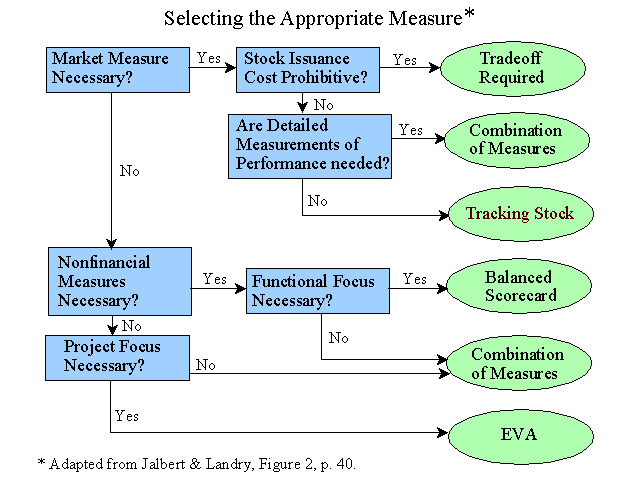
When choosing which technique to use, managers must consider what needs to be measured and the costs incurred. Based on the purpose of the measurements, companies can make a decision as to which measurement process to use. Combinations of the measurement techniques can be employed, but must be done so cautiously. The increased caution is needed because of complexity and cost issues. Companies need to research the methods that will be employed and understand what areas need to be measured. An adaptation of the authors' flowchart for selecting measurements appears below.
_____________________________________________
Related summaries:
Bacidore, J. M., J. A. Boquist, T. T. Milbourn and A. V. Thakor. 1997. The search for the best financial performance measure. Financial Analysts Journal (May/June): 11-20. (Summary).
Chan, Y. L. and B. E. Lynn. 1991. Performance evaluation and the analytic hierarchy process. Journal of Management Accounting Research (3): 57-87. (Summary).
Clinton, B. D. and S. Chen. 1998. Do new performance measures measure up? Management Accounting (October): 38, 40-43. (Summary).
Dierks, P. A. and A. Patel. 1997. What is EVA, and how can it help your company? Management Accounting (November): 52-58. (Summary).
Epstein, M. J. and S. D. Young. 1999. Greening with EVA. Management Accounting (January): 45-49. (Summary).
Fera, N. 1997. Using shareholder value to evaluate strategic choices. Management Accounting (November): 47-51. (Summary).
Ittner, C. D. and D. F. Larcker. 1998. Innovations in performance measurement: Trends and research implications. Journal of Management Accounting Research (10): 205-238. (Summary).
Ittner, C. D. and D. F. Larcker. 2003. Coming up short on nonfinancial performance measurement. Harvard Business Review (November): 88-95. (Summary).
Ittner, C. D., D. F. Larcker and M. W. Meyer. 2003. Subjectivity and the weighting of performance measures: Evidence from a balanced scorecard. The Accounting Review (July): 725-758. (Note).
Kaplan, R. S. and D. P. Norton. 1992. The balanced scorecard - Measures that drive performance. Harvard Business Review (January/February): 71-79. (Summary).
Kaplan, R. S. and D. P. Norton. 1996. Using the balanced scorecard as a strategic management system. Harvard Business Review (January-February): 75-85. (Summary).
Martin, J. R. Not dated. Balanced scorecard concepts. Management And Accounting Web. (Summary).
Norreklit, H. 2003. The balanced scorecard: What is the score? A rhetorical analysis of the balanced scorecard. Accounting, Organizations and Society 28(6): 591-619. (Summary).
Lev, B. 2004. Sharpening the intangibles edge. Harvard Business Review (June): 109-116. (Summary).
Stivers, B. P., T. J. Covin, N. G. Hall and S. W. Smalt. 1998. How nonfinancial performance measures are used. Management Accounting (February): 44, 46-49. (Summary).
Tatikonda, L. U. and R. J. Tatikonda. 1998. We need dynamic performance measures. Management Accounting (September): 49-53. (Summary).
Wallace, J. S. 1998. EVA® Financial systems: Management perspectives. Advances in Management Accounting (6): 1-15. (Summary).