Summary by Justin Gerber
Master of Accountancy Program
University of South Florida, Summer 2003
Kohn and Pfeffer | Behavioral
Issues Main Page | Deming Main Page
The purpose of this article is to bridge the gap between knowledge and speculation about what motivates employees. Herzberg discusses various myths about motivation, and explains his now famous motivation-hygiene theory.
Motivating with KIT
Many difficulties exist with moving employees to action. The quickest way to get an employee to do something is to ask, but if the person declines, the next solution is to give them a kick in the pants (KITA). However, there are problems with KITA and motivation. The employee, of course, does move when the KITA is applied, whether it is physical or psychological, but KITA does not lead to motivation, it only leads to movement. If an employee needs no outside stimulation, then he or she wants to do it.
Myths about Motivation
Next Herzberg confronts KITA practices that were developed to instill motivation.
1. Reducing time spent at work - The idea here is to motivate people to work by getting them off the job. The truth is that motivated people seek more hours, not
less.
2. Spiraling Wages - Spiraling wages motivates people to seek the next wage increase. If rising wages won’t motivate, reducing them might.
3. Fringe Benefits - These benefits have gone from rewards to rights. The cost of fringe benefits is approximately 25% of the wage dollar. People are spending less time working
expecting more security and money. Fringe benefits do not motivate.
4. Human Relations Training - More than 30 years of teaching and training and the question is still the same: How do you motivate employees?
5. Sensitivity Training - Because of the failure of Human Relations Training, sensitivity training was developed. Many
employees were forced to get to know themselves better and no motivation was garnered.
6. Communications - This was the next management training program to instill motivation. The idea was to let employees understand what management
was trying to do for them. But communication didn’t lead to motivation, it only lead to management realizing that it was not listening to employees.
7. Two Way Communication - Management now began welcoming suggestions and surveys. The two-way communication brought some improvement, but still had no motivating effect.
8. Job Participation - Job participation was designed to give employees the sense of achievement, or to show the employee the big picture.
This, of course, doesn’t lead to motivation.
9. Employee Counseling - Employees could talk to someone about their problems and perhaps that would motivate them. But the counseling also failed to yield the desired results. In fact,
counseling services were often interfering with the operation of the organization itself.
Hygiene vs. Motivators
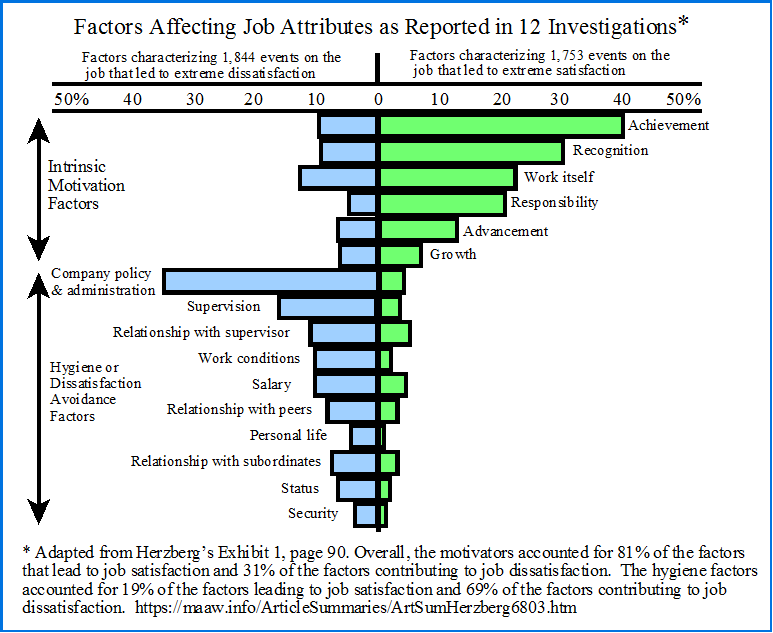
Herzberg developed a motivation-hygiene theory based on a study of engineers and accountants. The findings of the initial study suggest that factors involved in producing job satisfaction (and motivation) are different from the factors that lead to job dissatisfaction (hygiene). These findings have been replicated by sixteen other investigations.
The problem with semantics is resolved when understanding human behavior. Two differing needs are involved. One set of needs comes from the animal-like nature – built in drive to avoid pain and all other biological needs that drive humans. For example, hunger, makes it necessary to make money, and thus money is a specific drive. The other need is the ability to achieve and to experience growth. The tasks that satisfy the growth need are found in the job content, but also factors that induce pain-avoidance behavior are found on the job. Growth or motivator factors are achievement, recognition, work itself, responsibility, advancement and growth. The dissatisfaction avoidance or hygiene factors are company policy and administration, supervision, relationship with supervisor, working conditions, salary, relationship with peers, personal life, relationship with subordinates, status, and security. See below for a graphic view of the results of twelve of Herzberg's investigations.
The motivation-hygiene theory proposes that work must be enriched to successfully utilize, or motivate, personnel. Job enrichment provides the opportunity for growth. Job enrichment must be vertical job loading and not horizontal job loading. Horizontal loading consists of challenging the employee to increase production amounts or adding another meaningless task to the existing one. Vertical job loading could be removing controls while keeping accountability and introducing new and more challenging tasks not previously handled. Job enrichment needs to be a continuous management function according to Herzberg.
Conclusion
Herzberg disputes the ideas shared by managers that money and benefits motivate employees. Instead, Herzberg believes continuous job enrichment will motivate employees. He provides ten steps at the end of the article that managers should follow to implement his motivation-hygiene theory.
__________________________________________________________
Related summaries:
Amabile, T. M. 1998. How to kill creativity: Keep doing what you're doing. Or, if you want to spark innovation, rethink how you motivate, reward, and assign work to people. Harvard Business Review (September-October): 77- 87. (Summary).
Bailey, C. D., L. D. Brown and A. F. Cocco. 1998. The effects of monetary incentives on worker learning and performance in an assembly task. Journal of Management Accounting Research (10): 119-131. (Summary).
Banker, R. D., G. Potter and R. G. Schroeder. 1993. Reporting manufacturing performance measures to workers: An empirical study. Journal of Management Accounting Research (5): 33-55. (Summary).
Beard, A. 2017. The theory: "If you understand how the brain works, you can reach anyone. A conversation with biological anthropologist Helen Fisher. Harvard Business Review (March/April): 60-62. (Summary).
Blake, R. R. and J. S. Moulton. 1962. The managerial grid. Advanced Management Office Executive 1(9). (The Grid).
Bonner, S. E. and G. B. Sprinkle. 2002. The effects of monetary incentives on effort and task performance: Theories, evidence, and a framework for research. Accounting, Organizations and Society 27(4-5): 303-345. (Summary).
Deming. W. E.1993. The New Economics For Industry, Government and Education. Cambridge: Massachusetts Institute of Technology Center for Advanced Engineering Study. (Summary).
Johnson, D. W., G. Maruyama, R. Johnson, D. Nelson and L. Skon. 1981. Effects of cooperative, competitive, and individualistic goal structures on achievement: A meta-analysis. Psychological Bulletin (89): 47-62. (Summary).
Katzenbach, J. R. and J. A. Santamaria. 1999. Firing up the front line. Harvard Business Review (May-June): 107-117. (Summary). The authors discuss five unique practices used by the Marine Corps).
Kohn, A. 1993. Why incentive plans cannot work. Harvard Business Review (September-October): 54-63. (Summary).
Levinson, H. 2003. Management by whose objectives? Harvard Business Review (January): 107-116. (Summary).
Martin, J. R. Not dated. What is the red bead experiment? Management And Accounting Web. DemingsRedbeads.htm
McGregor, D. M. 1957. The human side of enterprise. Management Review (November): 22-28. Reprinted from the Proceedings of the Fifth Anniversary Convocation of the School of Industrial Management, MIT, April 9, 1957. (Summary).
Nicholson, N. 2003. How to motivate your problem people. Harvard Business Review (January): 57-64. (Summary).
Ouchi, W. G. 1979. A Conceptual Framework for the Design of Organizational Control Mechanisms. Management Science (September): 833-848. (Summary 2).
Ouchi, W. G. and A. M. Jaeger. 1978. Type Z organization: Stability in the midst of mobility. Academy of Management Review. (April): 305- 314. (Summary).
Pfeffer, J. 1998. Six dangerous myths about pay. Harvard Business Review (May-June): 109-119. (Summary).
Rigby, D. K., J. Sutherland and H. Takeuchi. 2016. Embracing agile: How to master the process that's transforming management. Harvard Business Review (May): 40-50. (Summary).