Note by James R. Martin, Ph.D., CMA
Professor Emeritus, University of South Florida
Deming Main Page | Education Issues Main Page
A pass or fail system is used for professional exams (e.g., Bar, CPA, CMA, CIA etc.) and could be used in schools. These systems are really pass or incomplete systems because parts of these exams can be passed at different times when the student is ready. One of the main problems for schools is that degree programs, as opposed to professional certification programs, are time based rather than competency based. As Deming points out, grades, typical in time based programs, place everyone along some arbitrary scale of achievement determined by the teacher. However, when a "P", or any other grade, is guaranteed for every student, the emphasis shifts totally to intrinsic motivation. In a system where extrinsic motivation (grading) has been emphasized, many students will not have enough intrinsic motivation to promote the desired amount of learning in a time based program (See Deming's Effects of Ranking People Illustration).
Some combination, or balance between intrinsic and extrinsic motivation appears to be needed. Perhaps students should be given an "I" for incomplete or delay in passing rather than failing, but if there is no penalty for not learning, many will not learn and degree programs would become continuing education programs. In a pass or fail program there would be no reason for students to compete for a grade and more motivation to cooperate and help each other. A key would be where to draw the line between pass and fail.
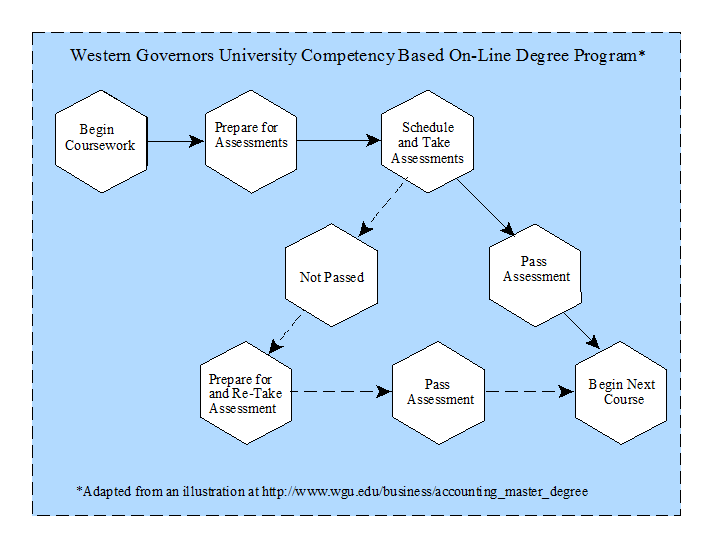
Western Governors University may have solved this problem. It has competency based on-line degrees with no credit hours and no grades. Degrees are based on a series of assessments that measure competencies. See the illustration below and my note on the Kamenetz article for more changes in higher education and links to WGU and other related sites.
___________________________________________________________
Some articles on grades and grading.
Abrami, P. C., W. J. Dickens, R. P. Perry, and L. Leventhal. 1980. Do teacher standards for assigning grades affect student evaluations of instruction? Journal of Educational Psychology (72): 107-118.
Bruner, J. S. 1961. The act of discovery. Harvard Educational Review (31): 21-32.
Butler, R. 1987. Task-involving and ego-involving properties of evaluation. Journal of Educational Psychology (79): 474-482.
Butler, R. 1988. Enhancing and undermining intrinsic motivation. British Journal of Educational Psychology (58): 1-14.
Butler, R., and M. Nissan. 1986. Effects of no feedback, task-related comments, and grades on intrinsic motivation and performance. Journal of' Educational Psychology (78): 210-216.
Campbell, D. N. October 1974. On being number one: Competition in education. Phi Delta Kappan (October): 143-146.
Condry, J., and J. Chambers. 1978. Intrinsic motivation and the process of learning. In The Hidden Costs of Rewards: New Perspectives on the Psychology of Human Motivation, edited by M. R. Lepper and D. Greene. Hillsdale, N.J.: Lawrence Erlbaum.
Grolnick, W. S., and R. M. Ryan. 1987. Autonomy in children's learning: An experimental and individual difference investigation. Journal of Personality and Social Psychology (52): 890-898.
Harter, S. 1978. Pleasure derived from challenge and the effects of receiving grades on children's difficulty level choices. Child Development (49): 788-799.
Kage, M. 1991. The effects of evaluation on intrinsic motivation. Paper presented at the meeting of the Japan Association of Educational Psychology, Joetsu, Japan.
Kamenetz, A. 2009. Who needs Harvard? Free online courses, Wiki universities, Facebook-style tutoring networks - American higher education is being transformed by a cadre of web-savvy edupunks. Fast Company (September): 84-89. (Summary).
Kirschenbaum, H., R. W. Napier, and S. B. Simon. 1971. Wad-Ja-Get?: The Grading Game in American Education. New York: Hart.
Kohn, A. 1992. No Contest: The Case Against Competition. Boston: Houghton Mifflin.
Kohn, A. 1993. Choices for children: Why and how to let students decide. Phi Delta Kappan (September): 8-20.
Kohn, A. 1999. Punished By Rewards: The Trouble with Gold Stars, Incentive Plans, A's, Praise, and Other Bribes. Boston: Houghton Mifflin.
Martin, J. R. 1998. Evaluating faculty based on student opinions: Problems, implications and recommendations from Deming’s theory of management perspective. Issues in Accounting Education (November): 1079-1094. (Summary).
Milton, O., H. R. Pollio, and J. A. Eison. 1986. Making Sense of College Grades. San Francisco: Jossey-Bass.
Moeller, A. J., and C. Reschke. 1993. A second look at grading and classroom performance. Modern Language Journal (77): 163-169.
Nicholls, J. G., and S. P. Hazzard. 1993. Education as Adventure: Lessons from the Second Grade. New York: Teachers College Press.
Oakes, J. 1985. Keeping Track: How Schools Structure Inequality. New Haven: Yale University Press.
Powell, R. W. 1977. Grades, learning, and student evaluation of instruction. Research in Higher Education (7): 193-205.
Vasta, R., and R. F. Sarmiento. 1979. Liberal grading improves evaluations but not performance. Journal of Educational Psychology (71): 207-211.
Worthington, A. G., and Wong, P. T. P. 1979. Effects of earned and assigned grades on student evaluations of an instructor. Journal of Educational Psychology (71): 764-775.