Chapter 11 CVP Example - Cal Company
James R. Martin, Ph.D., CMA
Professor Emeritus, University of South Florida
Chapter 11 | MAAW's Textbook Table of Contents
The Cal Company produces pocket size calculators that are sold for $10 per unit. The costs associated with each unit are as follows:
Direct material $3.00
Direct labor $0.25
Variable overhead $2.00
Variable selling and administrative cost $0.75
Fixed manufacturing costs $100,000
Fixed selling and administrative costs $20,000
The company’s tax rate is 40%.
In a recent meeting, the board of directors asked the following questions. How many calculators do we need to produce and sell to accomplish each of the following requirements?
1. Break-even.
2. Earn net income before taxes of $40,000.
3. Earn net income after taxes of $24,000.
4. Earn a 20% return on sales before taxes.
5. Earn a 12% return on sales after taxes.
To answer these questions, we start by calculating the contribution per unit as follows:
Contribution margin per unit = P - V = 10 - (3 + .25 + 2 + .75) = 10 - 6 = 4.
Then, the five questions are answered by using the equations from Exhibit 11-1.
1. Break-even.
4X = 120,000
X = $120,000 ÷ 4 = 30,000 units.
2. Earn net income before taxes of $40,000.
4X = 120,000 + 40,000
X = 160,000 ÷ 4 = 40,000 units.
3. Earn net income after taxes of $24,000.
4X = 120,000 + [24,000 ÷ (1-.4)]
4X = 120,000 + 40,000
X = 160,000 ÷ 4 = 40,000 unit.
4. Earn a 20% return on sales before taxes.
4X = 120,000 + .2(10X)
4X = 120,000 + 2X
2X = 120,000
X = 120,000 ÷ 2 = 60,000 units.
5. Earn a 12% return on sales after taxes.
4X = 120,000 + [.12(10X) ÷ (1-.4)]
4X = 120,000 + .2(10X)
4X = 120,000 + 2X
2X = 120,000
X = 120,000 ÷ 2 = 60,000 units.
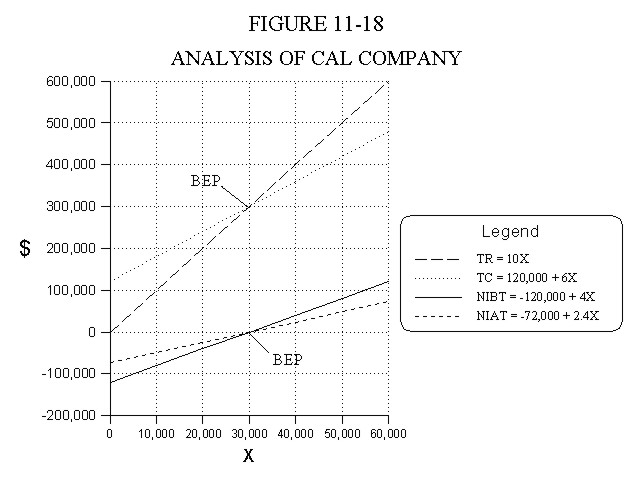
A graphic solution to Example 11-1 is illustrated in Figure 11-18.
Using The After Tax Equations As An Alternative
The equation for NIAT that appears in the graph is found by multiplying the equation for NIBT by (1-T) , i.e., (1-.4)(-120,000 + 4X) = -72,000 + 2.4X. Rearranging this equation we have 2.4X = 72,000 + NIAT. This revised equation indicates that the contribution margin after taxes ($2.4X) is equal to fixed costs after taxes ($72,000) plus the desired after tax income. It provides an alternative way to find the answers to questions 3 and 5 as illustrated below.
3. Earn net income after taxes of $24,000.
2.4X = 72,000 + NIAT desired
2.4X = 72,000 + 24,000
2.4X = 96,000
X = 96,000 ÷ 2.4 = 40,000 units.
5. Earn a 12% return on sales after taxes.
2.4X = 72,000 + NIAT desired
2.4X = 72,000 + .12(10X)
2.4X = 72,000 + 1.2X
1.2X = 72,000
X = 72,000 ÷ 1.2 = 60,000 units.
Checking the Solutions
The accuracy of linear cost-volume-profit calculations can be verified easily. For example, the answers to the questions above can be verified as follows:
1. Is 30,000 units the break-even point? Yes, since total contribution margin is equal to total fixed cost of 120,000, i.e., (4)(30,000) = $120,000.
2. Will 40,000 units generate a before tax profit of $40,000? Yes, because total contribution margin is (4)(40,000) = $160,000 and this amount is 160,000 - 120,000 = $40,000 above total fixed costs.
3. Will 40,000 units generate an after tax profit of $24,000? Yes, since (1-.4)($40,000 NIBT) = $24,000.
4. Will 60,000 units provide a 20% return on sales before taxes? Yes, since the NIBT is TCM - TFC or (4)(60,000) - 120,000 = $120,000. Sales equals PX or ($10)(60,000) = $600,000. R = 120,000 ÷ 600,000 = .20 or 20%.
5. Will 60,000 units provide a 12% return on sales after taxes. Yes, (1-.4)(.2) = .12 or 12%. For an alternative check (1-.4)(120,000) = $72,000 NIAT. Therefore, the after tax rate of return is 72,000 ÷ 600,000 = .12 or 12%.