Summary by Jennifer Beck
Master of Accountancy Program
University of South Florida, Fall 2004
ABM Main Page |
German Accounting Main Page
The purpose of this article is to discuss the benefits of resource consumption accounting (RCA) and provide an example of its use. According to Van der Merwe and Keys, RCA is an approach to cost management that combines the best of the German methods and activity-based costing. The authors list the three pillars of RCA in the introduction. (See the Clinton & Keys summary for those concepts).
RCA Example
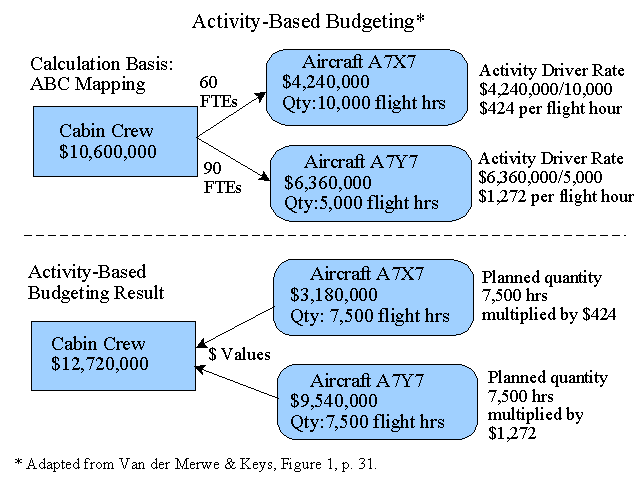
The example described in this article relates to the three pillars described by Clinton and Keys. It involves an airline that has two types of aircraft. There are 60 cabin crew members for the first type, the A7X7, and 10,000 flight hours. Eight crew members are needed for each flight. The second, larger airline, the A7Y7, has 90 crew members and a total of 5,000 flight hours. Twenty-four crew members are needed for each flight. The total expense for the period was $10.6 million. Figure 1 (See below) shows how these costs would be allocated between the two aircraft and how next year’s budget would be determined using ABB if both aircraft are expected to have 7,500 flight hours next year.
The authors point out three problems with the activity-based budgeting approach illustrated above:
1. ABB assumes that all costs are variable, but few activities actually have zero fixed costs,
2. ABB does not take planned excess or idle capacity into consideration, and
3. ABB doesn’t deal with non-monetary resources.
Activity-based resource planning (ABRP) is a more reliable method for calculating the resources needed and the dollar value of those resources used to support a business plan. There are four steps used to develop an ABRP system as follows:
Establish resource-pool-level unit standards for resource elements.
Establish resource output consumption unit standards with consumers.
Determine planned resource output demand.
Convert planned resource output demand into monetary equivalents.
The first step, establishing resource-pool-level unit standards, is performed by relating the output of the pool with practical capacity, and thereby determining the costs of idle capacity. The table below (based on Table 3, p. 34) shows how this is accomplished for the crew cabin example when the actual utilization is 200,000 hours.
| Primary Costs | Fixed $$ | Prop $$ | |||
| Cabin crew-productive | 0 | $6,000,000 | |||
| Cabin crew-rest days | 0 | 1,500,000 | |||
| Cabin crew-excess capacity | $1,500,000 | 0 | |||
| Flight Allowance | 1,000,000 | 0 | |||
| $2,500,000 | $7,500,000 | ||||
| Secondary Costs | |||||
| Activity | Driver | Fixed Qty | Prop Qty | ||
| HR Benefits | # Adjustments | 150 | 0 | 15,000 | 0 |
| Facilities | Sq footage | 15,000 | 0 | 585,000 | 0 |
| $600,000 | 0 | ||||
| Total Resource Pool Costs | $3,100,000 | $7,500,000 | |||
| Unit Cost Rates | $15.50 | $37.50 |
Now the second step, establishing resource output consumption unit standards can be calculated. For the airline example, standard consumption is 8 cabin crew hours per flight hour for the A7X7, and standard consumption for the A7Y7 is 24 cabin crew hours per flight hour. The top half of Figure 2 (See Step 2 in the graphic below) shows the calculations for the dollar cost of each aircraft’s activity.
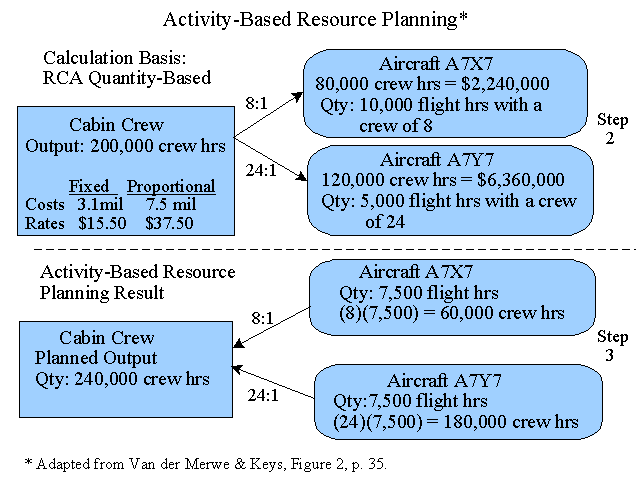
The third step is to determine the planned resource output demand. This is calculated by using the planned demand for flight hours and the unit standards previously established. The bottom half of Figure 2 (See step 3 in the graphic above) shows the calculations. Planned output is 240,000 cabin crew hours.
The final step is to convert the planned demand into monetary equivalents. This is demonstrated in the table below adapted from Table 4 on p. 34.
| Primary Costs | Fixed $$ | Prop $$ | |||
| Cabin crew-productive | 0 | $7,200,000 | |||
| Cabin crew-rest days | 0 | 1,800,000 | |||
| Cabin crew-excess capacity | 0 | 0 | |||
| Flight Allowance | 1,000,000 | 0 | |||
| $1,000,000 | $9,000,000 | ||||
| Secondary Costs | |||||
| Activity | Driver | Fixed Qty | Prop Qty | ||
| HR Benefits | # Adjustments | 150 | 0 | 15,000 | 0 |
| Facilities | Sq footage | 10,000 | 0 | 585,000 | 0 |
| $600,000 | 0 | ||||
| Total Resource Pool Costs | $1,600,000 | $9,000,000 | |||
| Unit Cost Rates | $6.67 | $37.50 |
Using ABRP, the total expected crew costs are $10,600,000 instead of $12,720,000 under activity-based budgeting. This difference occurs because RCA accounts for excess capacity and for fixed costs.
ABRP combines RCA principles with activity-based budgeting and provides more accurate projections of resource demand and costs. The advantages of RCA include:
1. Accurate projections of monetary equivalents for planning activities and outputs.
2. The ability to reconcile the demand for and supply of resources proactively.
3. Provide superior decision support for investment decisions related to resource demands.
4. Predict resource related impacts from various planning decisions such as training programs.
5. Derive comprehensive monetary plans with a quantity-based backflush approach.
For example, the last graphic illustration in the article (Figure 3, not provided here) shows that after sales quantities and sales mix are planned, production quantities and mix can be determined, followed by the determination of primary activities and resources, secondary activities and resources, and finally specific resource requirements.
_______________________________________________
Related summaries:
Gaiser, B. 1997. German cost management systems. Journal of Cost Management (September/October): 35-41. (Summary).
Gaiser, B. 1997. German cost management systems (part 2). Journal of Cost Management (November/December): 41-45. (Summary).
Keys, D. E. 1994. Tracing costs in the three stages of activity-based management. Journal of Cost Management (Winter): 30-37. (Summary).
Keys, D. E. and A. van der Merwe. 1999. German vs. U.S. cost management. Management Accounting Quarterly (Fall): 19-26. (Summary).
Keys, D. E. and A. van der Merwe. 2002. Gaining effective organizational control with RCA. Strategic Finance (May): 41-47. (Summary).
Sharman, P. A. 2003. Bring on German cost accounting. Strategic Finance (December): 30-38. (Summary).