Summary by Kerry A. Martin
Master of Accountancy Program
University of South Florida, Summer 2002
Japanese Management Main Page |
JIT Main Page | Target Costing Main Page
Product costing techniques are created and implemented to aid manufacturers in allocating costs to production items. Several methods have been developed, and provide different results.
When developing a new product in the U.S., the typical approach is to design it first and then compute the cost using a standard cost approach. Direct material, direct labor, and standard overhead costs are summed, and the resulting total is the new product cost. If the cost is too high, the product goes back to design or the company accepts a smaller profit. This approach to costing is being questioned in today’s manufacturing environment.
In the U.S., the purpose of standard costing is to practice management by exception; i.e., management's attention is directed towards situations where the actual results differ from the expected results. The expected results are based on standards set relative to the current manufacturing process. Therefore, standard costing reflects existing technology and fails to motivate improvements in the process.
Monden and Lee discuss the Kaizen costing technique that is used at Daihatsu, a Japanese car manufacturer, and compare it to the U.S. method of standard costing. Kaizen costing is a Japanese technique used to manage costs during a product's planning and design stages and has been used by some Japanese firms for over twenty years. It is now widely used in Japan in such industries as electronics, precision machinery, and automobiles. Its objective is to reduce current costs by using various improvement tools such as value engineering and functional analysis for each manufacturing facility. The term “Kaizen” translates as “continuous improvement”.
A manager in the United States generally expects to use cost information to make decisions about pricing or investments, while a Japanese manager expects to use cost information to reduce costs, the central theme of this article.
The chart below points out the primary differences in the two costing techniques.
| Standard Costing vs. Kaizen Costing |
| Standard Costing Concepts |
| Cost control system. Assume current manufacturing conditions. Meet cost performance standards. |
| Standard Costing Techniques |
| Standards are set annually or semiannually.
Cost variance analysis involving standard costs and actual costs. Investigate and respond when standards are not met. |
| Kaizen Costing Concepts |
| Cost reduction system. Assume continuous improvement in manufacturing. Achieve cost reduction targets. |
| Kaizen Costing Techniques |
| Cost reduction targets are set and applied monthly. Continuous improvement (Kaizen) is implemented during the year to attain target profit or to reduce the gap between target profit and estimated profit. Cost variance analysis involving target Kaizen costs and actual cost reduction amounts. Investigate and respond when target Kaizen amounts are not attained. |
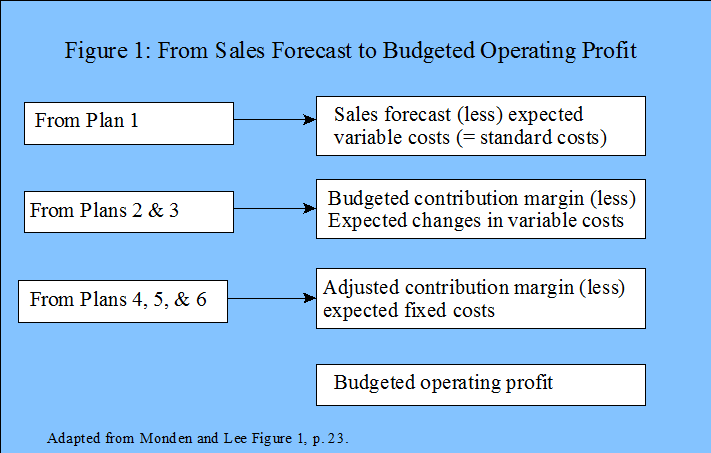
For a Japanese firm like Daihatsu that uses target costing, a new product project is established when a new product is proposed. The actual costing system is implemented during the initial design stage. There are 6 plans involved in the product process:
Plan 1 – Production, Distribution, and Sales Plan (which includes projections of contribution margins from sales).
Plan 2 – Projected Parts and Materials Costs.
Plan 3 – Plant Rationalization Plan (projected reductions in manufacturing variable costs).
Plan 4 – Personnel Plan (for direct labor work force and service department personnel).
Plan 5 – Facility Investment Plan (capital budget and depreciation).
Plan 6 – Fixed Expense Plan (for prototype design costs, maintenance costs, advertising and sales promotion expenses, and general and administrative expenses).
These six projections and plans become the annual profit budget or “target”:
Cost improvement through Kaizen is obtained by reducing variable and fixed costs. Functional analysis is applied at the design stage for a new product, and a target cost for each function is set. The functional target costs are summed, and the result is a product target cost. After the first year of production for a new product, the actual cost of the previous period becomes the starting point for further cost reduction. This process of continuous improvement is known as kaizen costing and encourages continual improvements by tightening the "standards."
Variable costs and fixed cost reductions are determined by separate methods. For variable costs, the actual prior year’s production cost serves as a standard base for current production. A reduction rate is then decided and variances are monitored. For fixed costs, the total budgeted amount is considered a target which is lowered by a reduction rate. Actual performance is compared to the budgeted amount with any reduction being considered favorable. The figure below provides a graphic view of Daihatsu's cost reduction approach.
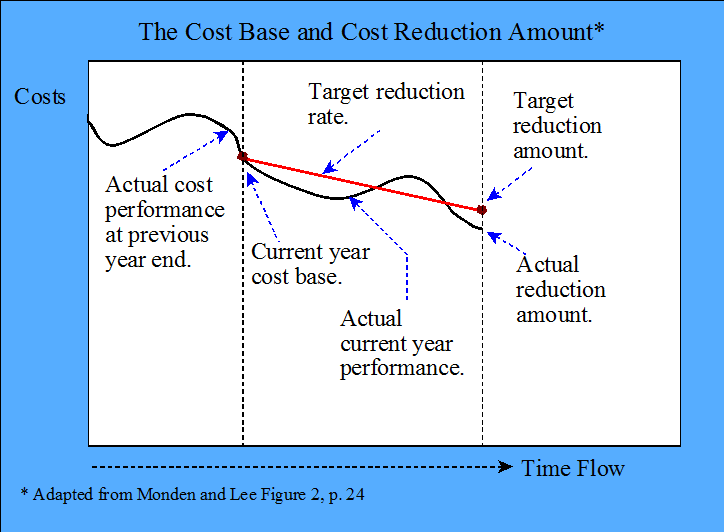
For Daihatsu, standard costs are steadily reduced by continuous improvement efforts towards the target cost. While the target cost is established during the design stage, standard costs (as well as other cost reduction techniques) are used during the production stage to attain the target cost. Thus, the standard costing system tracks progress in achieving the target cost.
Cost reduction techniques include standard costing. However, standard costing has limited applicability and can lead to undesirable results. For example, to minimize the purchase price variance, a purchasing manager may purchase a cheaper, lower quality part. As a result, the quality of the product is likely to be reduced, and the company may experience higher overall costs in the form of rework or warranty problems. In contrast, Kaizen costing is performed on a company-wide basis and can be used in planning, design, and other processes as well as production. Kaizen costing activities do not reduce the overall quality of the product; they do ensure that expenditures result in the receipt of appropriate value.
Monden and Lee’s article provides insight related to Kaizen costing and guidance on how management accounting can play a significant role in creating sustainable competitive advantages for a firm.
______________________________________________
Related summaries:
Chow, C. W., Y. Kato and K. A. Merchant. 1996. The use of organizational controls and their effects on data manipulation and management myopia: A Japan vs. U.S. comparison. Accounting, Organizations and Society 21(2-3): 175-192. (Summary).
Cooke, T. E. 1993. The impact of accounting principles on profits: The US versus Japan. Accounting and Business Research (Autumn): 460-476. (Summary).
Cooper, R. and C. A. Raiborn. 1995. Finding the missing pieces in Japanese cost management systems. Advances in Management Accounting (4): 87-102. (Summary).
Crawford, R. J. 1998. Reinterpreting the Japanese economic miracle. Harvard Business Review (January-February): 179-184. (Summary).
Dillon, L. 1990. Can Japanese methods be applied in the western workplace? Quality Progress (October): 27-30. (Summary).
Hayes, R. H. 1981. Why Japanese Factories Work, Harvard Business Review (July-August): 57- 66. (Summary).
Hiromoto, T. 1988. Another hidden edge: Japanese management accounting. Harvard Business Review (July-August): 22-25. (Summary).
Howell, R. and M. Sakurai. 1992. Management Accounting (and other) Lessons from the Japanese. Management Accounting (December): 28-34. (Summary).
Imai, M. 1986. Kaizen: The Key To Japan's Competitive Success. New York: McGraw-Hill Publishing Company. (Summary).
Ittner, C. D. and D. F. Larcker. 1997. Quality strategy, strategic control systems, and organizational performance. Accounting, Organizations and Society 22(3-4): 293-314. (Includes results for firms in the U.S., Canada, Germany, and Japan). (Note).
Johnson, H. T. and A. Broms. 2000. Profit Beyond Measure: Extraordinary Results through Attention to Work and People. New York: The Free Press. (Summary).
Lee, J. Y., R. Jacob and M. Ulinski. 1994. Activity-based costing and Japanese cost management techniques: A comparison. Advances In Management Accounting (3): 179-196. (Summary).
Martin, J. R., W. K. Schelb, R. C. Snyder, and J. C. Sparling. 1992. Comparing the practices of U.S. and Japanese companies: The implications for management accounting. Journal of Cost Management (Spring): 6-14. (Summary).
Porter, M. E., M. Sakakibara and H. Takeuchi. 2000. Can Japan Compete? (Perseus). (Summary).
Sakurai, M. 1989. Target costing and how to use it. Journal of Cost Management (Summer): 39-50. (Summary).
Sakurai, M. 1995. Past and future of Japanese management accounting. Journal of Cost Management (Fall): 21-30. (Summary).
Spear, S. and H. K. Bowen. 1999. Decoding the DNA of the Toyota production system. Harvard Business Review (September-October): 97-106. (Summary).
Takeuchi, H. 1981. Productivity: Learning from the Japanese. California Management Review (Summer): 5-18. (Summary).
Tanaka, T. 1993. Target costing at Toyota. Journal of Cost Management (Spring): 4-11. (Summary).
Tanaka, T. 1994. Kaizen budgeting: Toyota's cost-control system under TQC. Journal of Cost Management (Fall): 56-62. (Summary).
Wheelwright, S.C. 1981. Japan - Where operations really are strategic. Harvard Business Review (July-August): 67-74. (Summary).