Summary by James R. Martin, Ph.D., CMA
Professor Emeritus, University of South Florida
Decision Theory Main Page | Expert
Systems Main Page
Ege and Sullivan provide a brief explanation within an article by Brown and Phillips (See Brown, C. E. and M. E. Phillips. 1990. Expert systems for management accountants. Management Accounting (January): 18-23.)
According to Ege and Sullivan, an expert system is an area within the broader field of artificial intelligence and consist of a computer program designed to solve complex problems using the knowledge and reasoning of an expert. These systems are designed with specialized problem solving capabilities that are classified by task or function including the following:
1. interpretation - interpret, diagnose, monitor, and predict
2. generation - plan and design
3. debug
4. repair
5. instruct
6. control
7. learn.
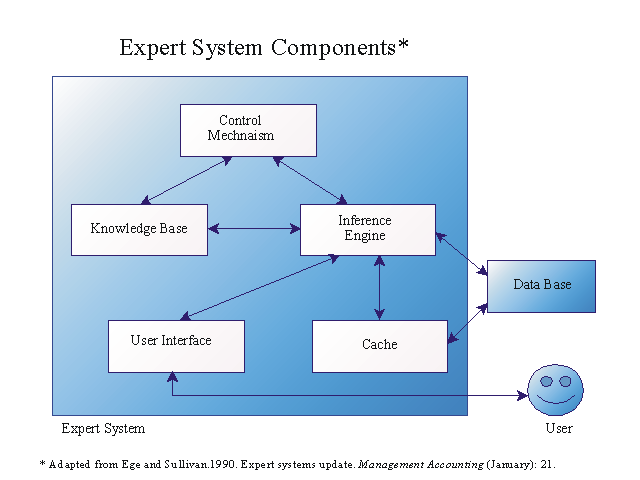
The key difference between these systems and other computer programs is that an expert system has the ability to explain and justify conclusions, and to handle incomplete and unreliable information. The components of an expert system include:
1. a knowledge base,
2. an inference engine,
3. a control mechanism,
4. cache - working memory, and
5. user interface.
The system may also interact with a database as shown in the graphic, but this is not a standard feature of all expert systems according to these authors. The main idea of an expert system is to provide expertise in places where human experts cannot be, to provide training tools, and to test the reasoning of experts.
____________________________________________
Related summaries:
Colvin, G. 2015. Humans are underrated. Fortune (August): 100-113. (Summary).
Davenport, T. H. and J. Glaser. 2002. Just-in-time delivery comes to knowledge management. Harvard Business Review (July): 107-111. (Summary).
Johnson, R. A. and J. M. Middleton. 2008. Accounting for second life. Journal of Accountancy (June): 54-58. (Summary).
Kaplan, A. M. and M. Haenlein. 2009. The fairyland of Second Life: About virtual social worlds and how to use them. Business Horizons 52(6): 563-572. (Summary).
Staats, B. R. and D. M. Upton. 2011. Lean knowledge work: The "Toyota" principles can also be effective in operations involving judgment and expertise. Harvard Business Review (October): 100-110. (Summary).
Williams, S. 2011. 5 Barriers to BI success and how to overcome them. Strategic Finance (July): 26-33. (Note).