Summary by Eileen Z. Taylor
Ph.D. Program in Accounting
University of South Florida, Spring 2004
Behavioral Issues Main Page | Research Methods Main Page
Covaleski and Aiken propose that accounting researchers can benefit by taking an organizational approach to investigating how accounting and its roles impact the coordination and control in an organization. They present a history of the development of accounting and then provide a framework that views accounting from a sociological perspective. This framework is then used to identify research opportunities for the study of accounting as an organizational control.
A Historical Perspective of Organizations
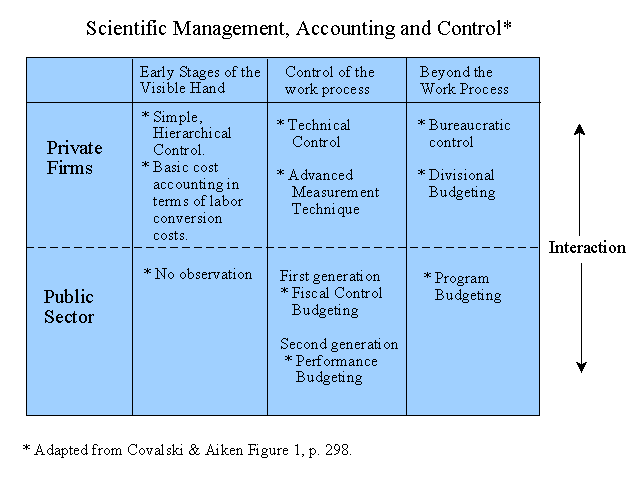
The beginnings of the idea of organizational control were found in the private sector, as individuals became employees and the ‘ “visible hand” of management replac(ed) the “invisible hand” of market forces.’ Cost accounting in this time was used to estimate actual labor conversion costs, that until then were determined by the marketplace. Subsequently, capitalists used accounting information to control the work process. This was marked by technical control and advanced measurement techniques. The public sector became involved with the advent of scientific management identified by the authors as first generation. The focus at the time was on fiscal control budgeting. Accountability and expenditure justification was the theme. The stock market crash of 1929 ended that movement. The second generation changed the emphasis to accounting as a system to aid in the social reform movement. Through budgeting, government agencies could be judged as effective (or not).
Control then went beyond control of the work process. In the private sector, this was evidenced by bureaucratic control; distinguished by its connection with social structures in the workplace. In an effort to concentrate capital and accumulate wealth, new tools were put in place; all with the effect of tying the employee to the organization and controlling all aspects of the business. The impetus for this development was the contradiction between production processes which were guided by scientific management, and distribution systems, which were still subject to market forces. Thus, the visible hand of management stepped in to organize the flows into and out of the firm. We know this as vertical integration.
Changes in accounting paralleled changes in the control structure. Where accounting once focused on production alone; it now was used to monitor and provide information throughout the firm. There was a focus on divisional budgeting and intra-organizational information transfer.
In the public sector, accounting was used for budgeting purposes. Planning and resource allocation were both facilitated through program budgets.
Interaction between Public and Private Sectors
Having covered the development in both the public and private sectors, the authors then focus on the interaction between the two. They point to Larson (1977) who states that the public sector’s progressivism led the way for the private sector to adopt scientific management principles. Kolko (1963) attributes the interaction to political capitalism. This led to a partnership between politics and big business that continues today (summary author’s emphasis).
A Historical Perspective on Theories of Organization
The authors provide a review of the early organizational theories and sociological approaches to studying organizations. The table below list these theories and the related accounting research perspectives and represents an adaptation of their Table 1. Each theory is discussed below.
| Table 1 A Historical Perspective on Theories of Organizations and Accounting Research |
||
| Early Organization Theories | Accounting Research Perspectives | |
| I. Scientific Management | Application of accounting in the monitoring of individuals & work units. | |
| II. Classical or Administrative Management | Application accounting in terms of departmental responsibility. | |
| III. Human Relations | Application of accounting in a concern for the motivation & aspiration levels of individuals to be controlled. | |
| IV. Decision-making perspective | Application of accounting in management decision making under conditions of uncertainty. | |
| Sociological Approaches | Accounting Research Perspective | |
| I. The Functional Tradition | a. Functionalism | Limited emphasis on internal organizational process. |
| b. Comparative Structuralists | Limited emphasis on internal organizational process. | |
| c. Comparative Structural Contingency | Application and design of accounting control systems contingent upon the nature of the host organization. | |
| d. Population Ecology | Limited emphasis on internal organizational process. | |
| II. Political Economy Perspective | Concern for the role of accounting in the interplay of power, goals and exchange systems. | |
| III. Classical Perspectives | a. Marxists | Concern for the role of accounting in the origin, design and workings of control systems in organizations. |
| b. Weber | Concern for the role of accounting in the increasing rationalization of contemporary society. | |
Early Organizational Theories
Scientific Management
Scientific management provides a strong link between organization and accounting research. Accounting information was used to support control over the work process in pursuit of efficiency and productivity. Taylor’s scientific management applied not only to control over individual workers, but structuring of divisions, and proper assignment of managers. Accounting allowed managers to best allocate resources, as well as evaluate performance. The “objective” nature of accounting made it especially well-suited to this type of organizational control.
Human Relations
Early theorist Elton Mayo introduced a human relations perspective into organizational theory. Specifically, organizations should consider social and psychological factors when designing production processes. This would enhance efficiency and communication. Argyris (1952) applied this perspective to accounting; specifically in the form of participative budgeting.
Decision-Making Perspective
March and Simon (1958) brought forth the decision-making perspective. It was characterized by an emphasis on individual participants. These ‘decision-makers’ had an unfulfilled need for good, relevant information that went unmet by the organization. Accounting provided some of this information and thus assisted in reducing uncertainty in organizations.
Sociological Approaches to the Study of Organizations
Sociological approaches differ from early organizational theories in that the former takes the perspective of society, while the later takes the organization’s point of view.
The Functional Tradition
The functional tradition includes functionalism, comparative structuralists, comparative structural contingency, and population ecology. Early functionalists studied societies, their subparts, and how the integration of the subparts led to the survival of the group. Comparative structuralists analyzed organizations as a static structure, and did not examine organizational processes. Neither of the two provided an opportunity for accounting-related research.
The advent of comparative structural contingency, however, opened the door to accounting research topics. Contingency theorists examine the organization and its reactions to changes in technology and environment. Contingency theory of budgeting is just one example.
The population ecology model “attempts to explain how various environmental factors select those organizational forms that best fit given environments”(p.312). This approach has been criticized for eliminating human factors and focusing only on organizational structure. Hence, the authors do not see an opportunity here for accounting organizational research.
Political Economy Perspective
The political economy theory of Mayer Zald appears to offer opportunity for accounting research. This approach considers power structures and politics as drivers of the organization.
Classical Perspectives
Marxist theory focuses on how the current system of social control came to be. The authors state that the most important contribution is the identification of issues of social control and coordination as the central issues in the study of work and organization.(p. 313). The focus on control provides the link between Marxist theory and accounting theory.
Weber is also mentioned; however, his approach pursues applied science. The authors do mention that Weber might provide opportunity for accounting research along the lines of examining the role of accounting in “…increasing rationalization and bureaucratization in society.”(p. 313).
Some Unresolved Questions
The authors conclude with some unresolved questions.
What are the purposes of the field of accountancy and the field of organizational behavior?
What are the areas of greatest mutual concern between the fields of accounting and organizational behavior?
Is the potential for a fruitful dialogue between these two fields equally good in both the public and private arenas?
What are the research methods that have been utilized in these two fields in their concerns for issues of coordination and control?
______________________________________________________
Related summaries:
Chenhall, R. H. 2003. Management control system design within its organizational context: Findings from contingency-based research and directions for the future. Accounting, Organizations and Society 28(2-3): 127-168. (Summary).
Covaleski, M. A., M. W. Dirsmith and S. Samuel. 1996. Managerial accounting research: The contributions of organizational and sociological theories. Journal of Management Accounting Research (8): 1-35. (Summary).
Ferreira, A. and D. Otley. 2009. The design and use of performance management systems: An extended framework for analysis. Management Accounting Research (December): 263-282. (Summary).
Libby, T. and J. H. Waterhouse. 1996. Predicting change in management accounting systems. Journal of Management Accounting Research (8): 137-150. (Summary).
Macy, G. and V. Arunachalam 1995. Management accounting systems and contingency theory: In Search of effective systems. Advances in Management Accounting (4): 63-86. (Summary).
Martin, J. R. Not dated. 200 years of accounting history dates and events. Management And Accounting Web. AccountingHistoryDatesAndEvents.htm
Martin, J. R. Not dated. Frederick Winslow Taylor bibliography. Management And Accounting Web. FrederickTaylor.htm
Martin, J. R. Not dated. The concept of validity. Management And Accounting Web. ValidityNotes.htm
Neimark, M. and T. Tinker. 1986. The social construction of management control systems. Accounting, Organizations and Society 11(4-5): 369-395. (Summary).
Van der Merwe, A. 2007. Management accounting philosophy I: Gaping holes in our foundation. Cost Management (May/June): 5-11. (Summary).
Van der Merwe, A. 2007. Management accounting philosophy II: The cornerstones of restoration. Cost Management (September/October): 26-33. (Summary).
Van der Merwe, A. 2007. Management accounting philosophy III: The management accounting evaluation framework. Cost Management (November/December): 20-29. (Summary).
White, L. A., A. Van der Merwe, B. D. Clinton, G. Cokins, C. Thomas, K. Templin and J. Huntzinger. 2012. Conceptual Framework for Managerial Costing: Draft Report of the IMA Managerial Costing Conceptual Framework Task Force. IMA. (Summary).