Summary by Charles Hart
Master of Accountancy Program
University of South Florida, Summer 2003
Quality Related Main Page |
Constrained Optimization Main Page
The COQ Process and How Xerox Used It
Xerox initiated a program called Cost of Quality (COQ) in 1989 that saved the company $53 million. In subsequent years of the operation of COQ Xerox saved $77 million in 1990 and saved $20 million in 1991. Rather than analyze performance, COQ concentrates on tasks that have high opportunity costs and makes those tasks more efficient. This system of quality control was prevalent through the entire corporation and was vigorously supported by management. Xerox uses cost of quality as an integral part of the corporation’s renowned “Leadership through Quality” program.
Xerox’s U.S. Customer Operations (USCO) division created multifunctional empowered teams to call attention to areas of cost-savings opportunity throughout the division. The team’s primary overall mission in the COQ process was to make Xerox a “world class” service provider for their customers. The teams focused on the business process to identify mechanisms that were not working well or that appeared inefficient. The U.S. Customer Operations (USCO) division concentrated only on tasks they fully controlled. The division constructed a list of tasks that were blocking Xerox’s goal to concentrate primarily on customer service. These tasks were identified primarily on what had the highest opportunity costs for Xerox as a corporation. Later, they identified new projects through open brainstorming sessions and added them to their initial lists. USCO created their own separate reporting system using COQ data as a tool and guide for organizing priorities for quality improvement projects.
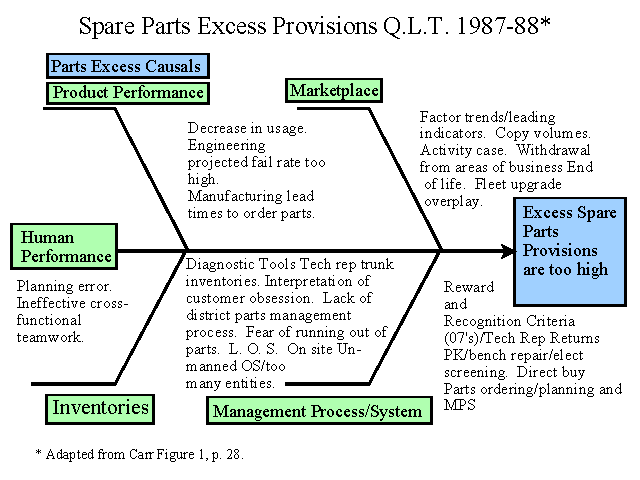
To properly understand the COQ system, consider the results attained by Xerox when using COQ to overcome difficulties they experienced with excess or cancellation of spare parts inventory. This expense for excess or obsolete spare parts cost Xerox more than $22 million or 7.3% of receipts a year. By any measure, this was a material amount.
Xerox’s USCO put one of their multifunctional empowered teams to work. The team used the problem-solving process, a Xerox quality tool, to identify actions necessary to reduce this figure. The process consisted of six steps:
1. Identify and select the problem,
2. Analyze the problem,
3. Generate potential solutions,
4. Select and plan solutions,
5. Implement solutions, and
6. Evaluate solutions.
Afterwards, the team identified four problems and solutions.
1. Excess inventory at field sites caused planners to order more parts than
necessary because they were too far down the chain to have control over the
inventory. There was no system for effective inventory use or no disciplined control process.
The solution was to establish a comprehensive field inventory management
system.
2. The spare parts failure rate was too high based on the stated engineering
specifications. The solution was to change
the spare parts management process by making engineering responsible for the
failure rates. Engineering also became
financially responsible for the excesses created by incorrect failure rates.
This change encouraged “getting it right the first time” one of the
cornerstones of Xerox’s quality program.
3. There was no product end-of-life strategy. Product planners did not communicate with parts planners.
The solution was to establish a communication network between the two
groups. This setup enabled better parts ordering as well as a centralized parts logistical system to support the old
equipment remaining in the field.
4. The parts planners set parts activity trends using product leading
indicators and product trend factors. The solution was to include data from repair activity and customer service
engineering, which contained specific parts usage. That change updated the revised consolidated parts planning database
monthly for the planners to review.
Cross-functional team members initiated a number of needed process changes, improved the data collection and analysis system, and changed some organizational accountability to match responsibilities. The COQ Excess/Cancel parts team continued to operate beyond this initial year because it felt additional implementation efforts were necessary to realize the solutions it had identified. Further refinement of the solutions would move the operation closer to the benchmark of 2.1%. As team members became more comfortable with each other and more familiar with the problem, they were able to challenge the parts logistical system more creatively. Their meetings became less formal, and each member enlisted the help of his or her colleagues to solve the problem. The project results overcame the high turnover of team members. There was no rigid protocol. Projects could cross function or be part of a single function. The goal was to solve the problem USCO and Xerox faced in a way that would save the most money.
COQ Applied at Xerox for the Long-run
As Xerox entered the nineties, they moved the COQ program from the central headquarters to out in the field. The COQ program remained in place, but its priority with management was greatly reduced. However, it remained one of the principal tools used to identify opportunities and initiate positive changes rather than analyze individual performance.
Part of Xerox’s quality strategy for the nineties was to achieve quarterly COQ reporting for the sales districts. The company examined lost opportunity (synonymous with COQ) die to quality from three areas: 1) Revenue (lost sales due to quality), 2) Process (costs due to business process inadequacies), and, expense (costs due to wasteful or excessive business expenses). Calculations were based on estimates and available accounting data. Internal benchmarks within three areas served as the comparison to determine the COQ or lost opportunity. The well-organized data, however, are a tool to help management identify areas that can improve revenue or reduce costs. The information motivated managers to improve performance and provided a credible internal comparison without analyzing performance.
The COQ system ended up working so well because it blended with corporate culture. This blend made the COQ system second nature to Xerox and it decision-making processes. The various tools – such as fishbone diagrams, problem-solving process, and especially the mind-set of continuous improvement – provide the correct atmosphere for COQ combustion. Managers are evaluated on their knowledge and support of the “leadership through Quality” program of which COQ is an element. Xerox made the definition and use of the quality cost part of its business operations.
Xerox uses the COQ program exclusively for identifying opportunities and setting priorities. It is an enabler. Managers realized at the outset that few identified cost-savings opportunities would arise if people were held individually accountable and were measured for a specific achievement level. No one wants to be penalized for identifying a cost-savings opportunity.
COQ became equated with 100% customer satisfaction.Both internal and external benchmarks serve as a reference for calculating the opportunity cost or COQ of achieving the desired operational level. Cost of quality is a dynamic concept that provides a useful economic metric of the overall business process improvement and a broad indicator of progress. Team empowerment and extensive training was conducted throughout the organization making enlisting everyone into the process. This approach made the COQ system familiar to everyone in the corporate structure. Users saw COQ as a valued tool for management.
The Future of COQ at Xerox
In time, managers lost interest in COQ. This was in part due to Xerox facing a major corporate reorganization and inadequate training for management. While senior management maintained its enthusiasm for the COQ process, estimated costs have started to exceed cost-savings opportunities. Additionally, it has now become harder for team members to identify potentially future valuable projects, which has created a real impasse for the organization. Next, the COQ program has drawn criticism because it does not measure individual performance. Meanwhile, Xerox has held fewer and fewer team meetings and training sessions for management and employees. Slowly, the knowledge base for COQ has begun to fade and the lack of results this has caused has threatened the entire COQ program.
Conclusion
Xerox had great success with the COQ program because it blended with their corporate structure, had the support of senior management, implemented by thorough training of all stakeholders, and could identify and solve lost opportunity easily for the corporation. Xerox had great success because it incorporated the COQ with all these vital ingredients. In time, Xerox was no longer able to use COQ effectively because these elements were no longer important or had been solved by Xerox. Therefore, any company can follow in Xerox’s success of the implementation of COQ but must be aware of how eventually the COQ system broke down at Xerox.
_____________________________________
Related summaries:
Albright, T. L. and H. Roth. 1992. The measurement of quality costs: An alternative paradigm. Accounting Horizons (June): 15-27. (Summary).
Albright, T. L. and H. Roth. 1993. Controlling quality on a multidimensional level. Journal of Cost Management (Spring): 29-37. (Summary).
Albright, T. L. and H. P. Roth. 1994. Managing quality through the quality loss function. Journal of Cost Management (Winter): 20-37. (Summary).
Anderson, S. W. and K. Sedatole. 1998. Designing quality into products: The use of accounting data in new product development. Accounting Horizons (September): 213-233. (Summary).
Carr, L. P. and L. A. Ponemon. 1994. The behavior of quality costs: Clarifying the confusion. Journal of Cost Management (Summer): 26-34. (Summary).
Deming, W. E. 1993. The New Economics for Industry For Industry, Government & Education. Cambridge: Massachusetts Institute of Technology Center for Advanced Engineering Study. Chapter 10. (Summary).
Fargher, N. and D. Morse 1998. Quality costs: Planning the trade-off between prevention and appraisal activities. Journal of Cost Management (January/February): 14-22. (Summary).
Gabel, N. 1991. Is 99.9% good enough? Training Magazine (March). (Summary).
Hughes, S. B. and D. M. Willis. 1995. How quality control concepts can reduce environmental expenditures. Journal of Cost Management (Summer): 15-19. (Summary).
Kettering, R. C. 2001. Accounting for quality with nonfinancial measures: A simple no-cost program for the small company. Management Accounting Quarterly (Spring): 14-19. (Summary).
Kim, M. W. and W. M. Liao. 1994. Estimating hidden quality costs with quality loss functions. Accounting Horizons (March): 8-18. (Summary).
Lucier, G. T. and S. Seshadri. 2001. GE takes six sigma beyond the bottom line. Strategic Finance (May): 40-46. (Summary).
Martin, J. R. Not dated. Constrained optimization techniques. Management And Accounting Web. ConstrainoptTechs.htm
Martin, J. R. Not dated. Lean concepts and terms. Management And Accounting Web. LeanConceptsandTermsSummary.htm
Martin, J. R. Not dated. Profit Beyond Measure graphics and notes. Management And Accounting Web. JohnsonBromsGraphicsNotes.htm
Martin, J. R. Not dated. What is lean accounting? Management And Accounting Web. LeanAccounting.htm
Morse, W. J. 1983. Measuring quality costs. Cost and Management (July-August): 16-20. (Summary).
Pasewark, W.R. 1991. The evolution of quality control costs in U.S. manufacturing. Journal of Cost Management (Spring): 46-52. (Summary).
Roehm, H. A., D. Klein and J. F. Castellano. 1995. Blending quality theories for continuous improvement. Management Accounting (February): 26-32. (Summary).
Roth, H. P. and T. L. Albright. 1994. What are the costs of variability? Management Accounting (June): 51- 55. (Summary).
Rust, K. G. 1995. Measuring the costs of quality. Management Accounting (August): 33-37. (Summary).
Sedatole, K. L. 2003. The effect of measurement alternatives on a nonfinancial quality measure's forward-looking properties. The Accounting Review (April): 555-580. (Summary) and
Shank, J. K. and V. Govindarajan. 1994. Measuring the "cost of quality": A strategic cost management perspective. Journal of Cost Management (Summer): 5-17. (Summary).
Sjoblom, L. M. 1998. Financial information and quality management - Is there a role for accountants? Accounting Horizons (December): 363-373. (Summary).
Taguchi, G. and D. Clausing. 1990. Robust quality. Harvard Business Review (January-February): 67-75. (Summary).