Summary by Melissa Dondero
Master of Accountancy Program
University of South Florida, Summer 2003
Performance Measurements Main Page | Strategy Main Page
The purpose of this article is to describe how General Motors developed and used a new performance evaluation system.
Introduction
In an effort to gain market share and recover from financial losses, General Motors adopted a philosophy of continuous improvement and synchronous manufacturing in the late 1980's. The goal of this program was to increase customer satisfaction through production and delivery of world-class products. To monitor the progress of this program, a new performance evaluation system was created.
Traditional Performance Evaluation Systems
Traditional performance evaluation systems are often based on historical financial measures such as earnings per share, return on investment, and budget variances. These measures do not provide information to evaluate management effectiveness, manufacturing productivity, product quality, or asset utilization. Traditional performance measures do not indicate whether an operation's performance is aligned with the organization's goals. Traditional performance measures can also lead employees to make decisions to benefit themselves instead of the company as a whole. GM developed a new performance evaluation system to overcome the problems of traditional evaluation systems.
Developing the New Performance Evaluation System
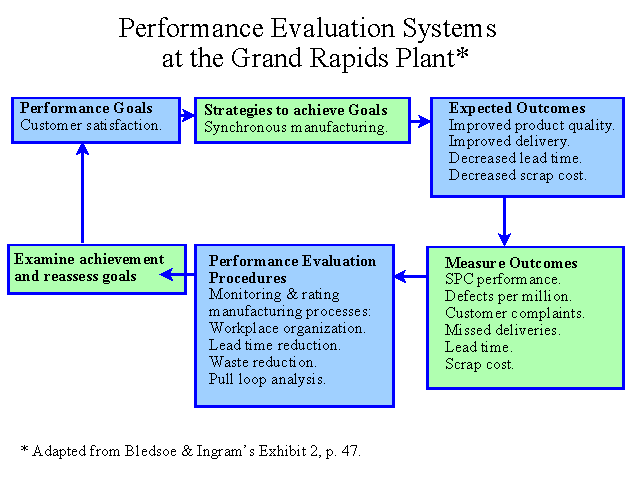
The first step in developing the new performance evaluation system was to identify customer satisfaction problems. General Motors identified four areas and defined goals for each:
1. Product quality - achieve zero defects and incorporate the features, performance, reliability, and durability
customers expect.
2. Delivery - increase the percentage of products delivered on schedule to the external customer or internal user.
3. Production lead time - reduce the
sum of processing, material movement, inspection, queuing, and storage times for
a particular product.
4. Waste - eliminate all non-value-added activities and resources incurred during the process of meeting customer
requirements.
The next step was to identify ways to improve customer satisfaction. To do this, employees were asked to make suggestions for improvements throughout the manufacturing process. Four areas for improvements were identified:
1. Workplace organization.
2. Visual controls.
3. Waste and lead time reduction.
4. Pull system implementation.
Finally, performance evaluation measures were identified for each customer satisfaction area:
1. Product quality - measured by:
a. Statistical process control performance.
b. Product defects per million.
c. Customer complaints
2. Delivery - measured by the percentage of time the plant meets customer requirements during a month.
3. Production lead time - measured by the average time spent manufacturing one unit of product.
4. Waste - measured by the average monthly scrap cost per unit.
The exhibit below illustrates the performance evaluation system.
Benefits of the New Program
General Motors has reaped many benefits from the implementation of the new evaluation program One benefit is that the organization has changed from a management structure where 150 people ran the plant to a structure based on employee empowerment where 1,150 work together to run the plant. The new program encourages the entire organization to take responsibility for the plant operations. The organization is now working towards its goals as a whole. Another benefit is that more employees are participating in making suggestions. The new program encourages employee suggestions and offers awards for recommendations that solve problems. Employees are held accountable for their role in the overall process instead of being evaluated on traditional measures that are mostly out of employee control.
Lessons Learned
The most difficult obstacle General Motors had to overcome was people's resistance to change. Management overcame this resistance with constant communication and consistent commitment to the program. General Motors management suggests that other companies who want to develop a new program should thoroughly investigate what other companies are doing beforehand. GM managers visited Federal Express, an egg packer and a cigarette manufacturer to learn how to improve various aspects of GM's operations. Research through such "visioning trips" provided the company with the information and knowledge required to successfully implement the operations change.
___________________________________________________
Related summaries:
Fullerton, R. R. 2003. Performance measurement and reward systems in JIT and non-JIT firms. Cost Management (November/December): 40-47. (Summary).
Fullerton, R. R. and C. S. McWatters. 2002. The role of performance measures and incentive systems in relation to the degree of JIT implementation. Accounting, Organizations and Society 27(8): 711-735. (Summary).
Imberman, W. 1995. Is gainsharing the wave of the future? Management Accounting (November): 35-39. (Summary).
Ittner, C. D. and D. F. Larcker. 1997. Quality strategy, strategic control systems, and organizational performance. Accounting, Organizations and Society 22(3-4): 293-314. (Note).
Kalagnanam, S. S. and R. M. Lindsay. 1998. The use of organic models of control in JIT firms: Generalising Woodward's findings to modern manufacturing practices. Accounting, Organizations and Society 24(1): 1-30. (Summary).
Lessner, J. 1989. Performance measurement in a just-in-time environment: Can traditional performance measurements still be used? Journal of Cost Management (Fall): 23-28. (Summary).
Martin, J. R. Not dated. Lean concepts and terms. Management And Accounting Web. LeanConceptsandTermsSummary.htm
Martin, J. R. Not dated. Profit Beyond Measure graphics and notes. Management And Accounting Web. JohnsonBromsGraphicsNotes.htm
Martin, J. R. Not dated. What is lean accounting? Management And Accounting Web. LeanAccounting.htm
Patell, J. M. 1987. Adapting a Cost accounting system to just-in-time manufacturing: The Hewlett-Packard Personal Office Computer Division. Accounting & Management Field Study Perspectives, edited by William J. Bruns, Jr. and R. S. Kaplan. Harvard Business School Press: 229-267. (Summary).
Vollmann, T. 1990. Changing manufacturing performance measurements. Proceedings of the Third Annual Management Accounting Symposium. Sarasota: American Accounting Association: 53-62. (Summary).